

Pope Leo on AI: Safeguarding Humanity Amid Technological Transformation

Photo courtesy of Anna Rowlands
A Panel Discussion with Boston College Faculty
Christina McRorie, Clough School of Theology and Ministry
Sam Ransbotham, Carroll School of Management
Brian K. Smith, Lynch School of Education and Human Development
Andrea Vicini, S.J., Theology Department
Moderated by: David T. Buckley, Boisi Center Director
Date: Tuesday, September 22, 2026
Time: 4 - 5:30pm
Location: Gasson Hall 100
Reception to follow
On May 15, Pope Leo signed Magnifica Humanitas, an encyclical letter “on safeguarding the human person in the time of AI.” At the encyclical’s May 25 launch event, Leo invited Anthropic co-founder Chris Olah to offer remarks, a sign of the Vatican’s desire for dialogue with those guiding the future of this powerful new technology. How does Magnifica Humanitas update Catholic social thought for our new technological age? And how have leaders in the private sector, government, and education responded to Leo’s urgent call? Join an interdisciplinary panel of Boston College experts to unpack Leo’s ground-breaking document, and discuss the place of religion in AI’s future.

Christina McRorie is associate professor of moral theology at the Boston College Clough School of Theology and Ministry. Her research is interdisciplinary, and draws from the Christian tradition, political economy, and economics to consider questions about moral agency and obligation in markets. She is the author of The World of Markets: A Theology of Moral Agency in Economic Life, and co-editor of Markets and Other Social Structures: Analyzing Moral Ecologies in Christian Ethics. She has served on the editorial boards of the Journal of Catholic Social Thought and the Journal of Moral Theology, and starting in 2027, she will serve as the co-editor of the Journal of the Society of Christian Ethics. In 2026, she was invited to join the Artificial Intelligence Research Group sponsored by the Dicastery for Culture and Education’s Centre for Digital Culture, for a project on AI and labor.

Sam Ransbotham is the Peter F. Drucker Chair of Management Sciences and Professor of Analytics at Boston College. While everyone seems to talk about artificial intelligence, Ransbotham is curious about what businesses are really doing—How are normal businesses using AI now? How will they use AI later? To learn more, he serves as editor for the MIT Sloan Management Review initiative on Artificial Intelligence in Business. Recently, he co-authored a research report, “The Emerging Agentic Enterprise: How Leaders Must Navigate a New Age of AI,” and co-hosts the “Me, Myself, and AI” podcast. Since 2015, he has been an editor for MIT SMR’s Big Ideas initiatives, including Artificial Intelligence and Business Strategy and Competing With Data & Analytics. Ransbotham earned a Bachelor’s degree in Chemical Engineering, an MBA, and a PhD, all from the Georgia Institute of Technology.

Brian K. Smith is the Honorable David S. Nelson Professor and Associate Dean for Research at the Lynch School of Education and Human Development. His research interests include the design of computer-based learning environments, human-computer interaction, design sciences, societal impacts of computation, out-of-school learning, and computer science education. He is a technical advisor to the Center for Inclusive Computing at Northeastern University, a program fellow with the Spencer Foundation, and chair of the World Usability Day Design Challenge. He also co-chairs the International Conference on Learning and Collaboration Technologies.
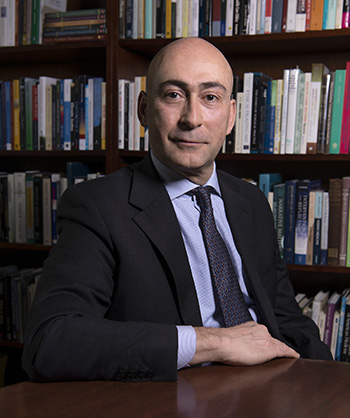
Andrea Vicini, S.J., is Chairperson, Michael P. Walsh Professor of Bioethics, and Professor of Theological Ethics in the Theology Department at Boston College. Medical doctor and pediatrician (University of Bologna), he is an alumnus of Boston College (STL and PhD) and holds a Sacred Theology Doctorate (STD) from the Pontifical Faculty of Theology of Southern Italy (Napoli). He is co-chair of the international network Catholic Theological Ethics in the World Church (CTEWC). His research includes fundamental moral theology, theological bioethics, global health, biotechnologies, and environmental issues. In 2015-2016, he was research fellow at the Center of Theological Inquiry (Princeton, NJ) on the societal implications of astrobiology. With the Artificial Intelligence Research Group for the Centre for Digital Culture of the Dicastery for Culture and Education of the Holy See, he co-authored Encountering Artificial Intelligence: Ethical and Anthropological Investigations (2023) and Reclaiming Human Agency in the Age of Artificial Intelligence (2025). He authored: Genetica umana e bene comune (2008) and co-edited: Intercultural Theological Ethics: Fundaments, Frameworks (2025); Plastic Pollution, Theological Ethics, and the Call of Laudato Si’ (2025); The Rising Global Cancer Pandemic: Health, Ethics, and Social Justice (2022); Ethics of Global Public Health: Climate Change, Pollution, and the Health of the Poor (2021); Reimagining the Moral Life: On Lisa Sowle Cahill’s Contributions to Christian Ethics (2020); Building Bridges in Sarajevo: The Plenary Papers of CTEWC 2018 (2019); Just Sustainability: Technology, Ecology, and Resource Extraction (2015); and The Legacy of Vatican II (2015).
Borge, M., B. K. Smith, and T. Aldemir. “Using Generative AI as a Simulation to Support Higher-Order Thinking.” International Journal of Computer-Supported Collaborative Learning 19, no. 4 (2024): 479–532. https://doi.org/10.1007/s11412-024-09437-0
Dias, Elizabeth. "Is Claude Conscious? Inside Anthropic’s Quest to Instill Morality Into Its A.I. Models." The New York Times, September 29, 2026. https://www.nytimes.com/2026/09/29/us/anthropic-claude-morals-ai.html
Kane, Gerald C., Amber Young, Ann Majchrzak, and Sam B. Ransbotham. “Avoiding an Oppressive Future of Machine Learning: A Design Theory for Emancipatory Assistants.” MIS Quarterly 45, no. 1 (2021): 371–96.
Leo XIV. Magnifica Humanitas. The Holy See, The Vatican. May, 2026. https://www.vatican.va/content/leo-xiv/en/encyclicals/documents/20260515-magnifica-humanitas.html
Leo XIII. Rerum Novarum. The Holy See. The Vatican. May, 1891. https://www.vatican.va/content/leo-xiii/en/encyclicals/documents/hf_l-xiii_enc_15051891_rerum-novarum.html.
Leone, Raimondo, et al. 2026. “From Rerum Novarum to Magnifica Humanitas: Catholic Social Doctrine and Decent Work.” Annals of Global Health 92, no. 1: 67. https://doi.org/10.5334/aogh.5366.
McRorie, C. G. “Moral Reasoning in ‘the World.’” Theological Studies 82, no. 2 (2021): 213–37. https://doi.org/10.1177/00405639211009939
Olah, Chris. "Anthropic Co-Founder Chris Olah's Remarks on Pope Leo XIV's Encyclical 'Magnifica Humanitas.'" Anthropic, May 25, 2026. https://www.anthropic.com/news/chris-olah-pope-leo-encyclical
Przygoda, Wiesław, Alina Rynio, and Michał Kalisz. 2025. “Artificial Intelligence: A New Challenge for Human Understanding, Christian Education, and the Pastoral Activity of the Churches.” Religions 16, no. 8: 948. https://doi.org/10.3390/rel16080948
Sullivan, Meghan. “Us vs. the Robots.” Commonweal Magazine, June 30, 2026. https://www.commonwealmagazine.org/sullivan-leo-delta-ai-magnifica-humanitas.
Vicini, Andrea. 2022. “Artificial Intelligence and Social Control: Ethical Issues and Theological Resources.” Journal of Moral Theology 11, no. SI1 (2022): 41–69. https://doi.org/10.55476/001c.34123.
Across virtually every dimension of society, artificial intelligence has spurred widespread transformation, sparking debates over who decides how we are to govern the growth and development of AI. In late September, Reuters reported that Pope Leo XIV said experts’ concerns about AI should be taken up seriously. The issues society faces due to AI are not “fake news” or hoaxes, but rather they are challenges that must be reconciled with preserving human dignity. Pope Leo made these claims in response to President Trump’s dismissal of growing concerns about the impacts of artificial intelligence. Leo’s Magnifica Humanitas addresses these concerns, drawing on the principles and traditions of Catholic Social Thought to negotiate how we can balance technological transformation with our shared moral duty as humans. His encyclical warns against the dangers of AI-centered development and considers how AI can advance society’s productivity while also protecting human dignity and common flourishing.

Dean Gregory Kalscheur, S.J. welcomes our guests to our first event of academic year 2026-2027 and introduces Boisi Center's new director, David Buckley.

Boisi Center director, David Buckley, moderates the panel on Pope Leo on AI: Safeguarding Humanity Amid Technological Transformation.

View of the panel and audience in Gasson Hall 100.

Panelist Christina McRorie is an associate professor of moral theology at the Boston College Clough School of Theology and Ministry.

Panelist Andrea Vicini, S.J., is chairperson, Michael P. Walsh Professor of Bioethics, and professor of theological ethics in the theology department at Boston College.

Panelist Brian K. Smith is the Honorable David S. Nelson Professor and associate dean for research at the Lynch School of Education and Human Development.

Panelist Sam Ransbotham is the Peter F. Drucker Chair of Management Sciences and professor of analytics at Boston College.

Bryson Giersch, one of the Boisi Center's Undergraduate Research Fellows, asks a question during the Q&A.
On September 22, the Boisi Center commenced its 2026-27 academic year’s events with a panel of four members of the Boston College faculty, moderated by new director David Buckley. Christina McRorie, Sam Ransbotham, Brian K. Smith, and Andrea Vincini offered theological and practitioner perspectives on how Pope Leo XIV’s Magnifica Humanitas applies traditions and principles of Catholic Social Thought to address the rapidly changing conditions of our digital age.
The panel began with theological perspectives on the stakes of AI for the Catholic social tradition. Christina McRorie of the Clough School of Theology and Ministry drew on Magnifica Humanitas to identify the "hidden labor chains" behind AI, arguing that digital data work often relies on exploitative practices that undermine the principles of human dignity and productive labor. McRorie argued that AI removes a crucial element of subjectivity from labor: the sense of respect and agency we gain from working in union with others, tending toward collective betterment. She emphasized that these exploitative processes behind AI, “digital sweatshops,” subject individuals to socially, psychologically, and spiritually damaging conditions. For both Pope Leo and McRorie, this labor does not achieve its appropriate ends in which we collaborate with God and society through productive, collective action.
Andrea Vicini, S.J., continued theological analysis, contextualizing the encyclical in the tradition of the Second Vatican Council's Gaudium et Spes. Drawing from these traditional principles, Vicini emphasized that Catholic doctrine calls for a contemplative engagement with the world to build a "civilization of love." For Vicini, the goal of those connected to the Church is to guide humanity in recognizing and living up to their accorded dignity. Thus, theological perspectives must play a crucial role in assessing how AI impacts human dignity. Vicini’s perspective is relevant especially for the marginalized, as he calls for a collective, participatory approach that includes understanding how each person can become more human, together.
Brian K. Smith of the Lynch School of Education and Human Development began the practitioner responses by reflecting on the urgent need for education to ensure that students’ reasoning abilities remain autonomous, and that they don’t resign their agency over to artificial intelligence. Smith argued that outsourcing our thinking to AI undermines the collaborative, honest, and open spirit of education that animates productive learning and helps communities flourish. Smith’s concerns speak to the impacts of AI, especially on the institution of education, emphasizing that we must be thoughtful and reflective in implementing digital tools so that they do not undermine the process of education.
Sam Ransbotham of the Carroll School of Management oriented the conversation towards AI in the corporate context, addressing the rise of autonomous "agentic" systems and the dangers of overreliance. Ransbotham described how companies integrate AI agents to perform complex, multi-step tasks independently, which can ultimately lead to the surrender of human agency to these technologies. As such, he emphasizes the crucial role human judgment and oversight must play in managing AI systems commercially, so we don’t surrender our autonomy to them.
Humanity must recognize the potential of artificial intelligence to harm society and work to identify steps to alleviate those emergent ills. Catholic Social Thought provides us with the theological and practical resources to do just that. Panelists spotlighted the importance of each individual contemplating what it means to be human, and using this reflection to take action strengthening humanity’s dignity in the wake of artificial intelligence. The extent to which the digital world influences, and will continue to influence, our society calls Catholic communities to action. The digital world requires moral legislation, as its impacts transcend the ambit of the commercial realm. Ultimately, Magnifica Humanitas raises an urgent question: as technological transformation comes to the fore, how do Catholics take up their role in communities of interpretation, orienting the productive and ethical forces of society toward the advancement of the common good?
Bryson Giersch, '28
Undergraduate Research Fellow