The Executive Ed.D. in Higher Education invites experienced leaders to ask hard questions about themselves, their institutions, and the future of higher education. You will engage global and international perspectives, use evidence to shape strategy, and lead with purpose in pursuit of social justice. Graduates sustain this work through a lifelong alumni community.
We're here to help!. Discuss your questions, hopes, and hesitations with our team. As you reflect, hear from the program director.
Discover the program’s guiding philosophy, the relationships that shape the cohort, and the residency experiences that change how leaders think and act.

Join a cohort of 15 accomplished leaders spanning Carnegie classifications and countries. The cohort becomes a council of trusted advisors who know your work well enough to challenge it, with relationships that continue long after graduation.
Produce the research serious leadership requires. Build the quantitative, qualitative, and analytical capacity to generate and weight evidence at the institutional, system, and policy levels to lead with purpose and judgment.
Explore higher education in a global context through international residencies and electives that draw on the expertise of the Center for International Higher Education.
Coursework is online, blending weekly 90-minute live sessions with independent work. Each summer, the cohort gathers in person for one week: first at Boston College, then abroad, then in a retreat environment.
Grow through formative experiences, sustained after graduation by annual retreats, group coaching, and alumni-led roundtables. Explore the enduring questions of who you are becoming and what your leadership makes possible.

The program opens on Boston College’s main campus. In the first full week of June, the cohort gathers on campus for the Doctoral Proseminar and Law, Policy, and Politics of Higher Education. Seminars, shared meals, and evenings in Boston introduce students to each other and to the intellectual life of the program. Tuition covers accommodations and most meals for all three residencies. Students cover airfare and visa costs.

In the second year, the cohort travels abroad. Residency locations rotate among major global cities, with past and future destinations including Dublin, Santiago, Milan, and others. Through Managing Change in Higher Education, students meet with university presidents, policymakers, and government officials, bringing their growing expertise into conversation with systems organized around different assumptions. The international residency is the second full week in June each year.

The final residency takes place at Boston College’s Connors Center, a retreat facility outside the city in Dover, MA. In Strategic Problem Solving through Design Thinking, students work through a human-centered design process to address a challenge framed by a stakeholder, developing and presenting a proposed solution with real-world stakes. Students in the Catholic Higher Education concentration also participate in the Institute for Administrators in Catholic Higher Education. The third residency is held in mid-July each year.
Students and faculty reflect on why leaders choose doctoral work at this stage of their lives, what a cohort of accomplished peers makes possible, and how the program continues to shape their leadership long after graduation.
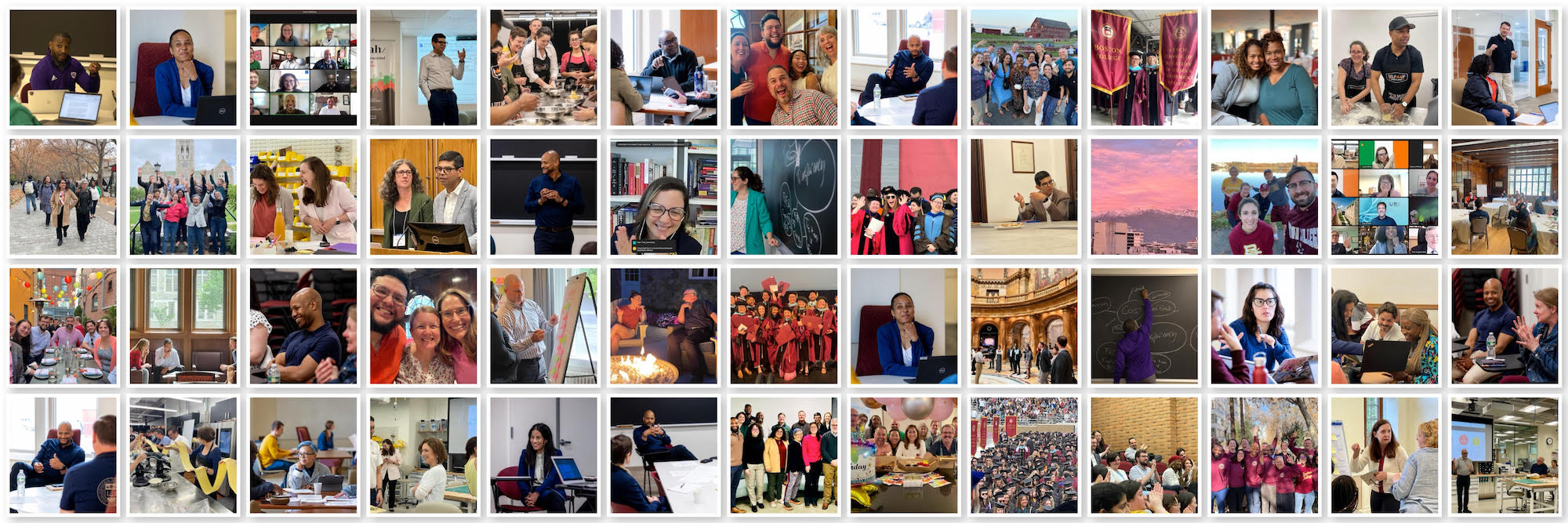
Cohorts of accomplished leaders bring experiences from a broad range of institutional types—research universities, liberal arts colleges, art and design schools, community colleges, nonprofits, and global networks, both U.S. and international—creating discussions that challenge assumptions and sharpen thinking on complex issues.

"Shaping national policy on state data systems, I need scholarly grounding equal to the decisions I make in practice.The program gives me the evidence-based frameworks to interrogate more critically how higher education can better deliver on its promises, and a cohort of campus leaders that keeps my policy work honest the realities institutions currently face."

"Working in an executive leadership office at a large public research university, I see external dynamics, constrained resources, and competing institutional priorities impact executive decision making. This program gives me the frameworks to build on that experience and strengthen my ability to help shape what comes next."

"After several years in international higher education, I value how closely BC's faculty mentor my research. They are helping me build frameworks for how universities decide what forms of knowledge to privilege or exclude, a question AI has made urgent."

"As someone committed to higher education as an engine of social mobility, this Executive Ed.D. equips me to navigate today's challenges—from managing diverse portfolios in resource-constrained environments to reimagining how universities can transcend political divisions and serve all learners."

“At a small diocesan Catholic liberal arts college in Montana, the leadership demands are real even if the scale looks different. The program is giving me frameworks for holding mission, resource constraint, and institutional identity at once, and a community of peers that continues well past graduation through retreats, roundtables, and ongoing formation."

"Coordinating twenty-nine Jesuit universities across thirteen countries means working at the intersection of institutional identity, regional context, and global mission. The program gives me the research depth to understand system-level change and a scholarly community that takes seriously what universities owe the societies they serve."
Students learn in an executive-style format that involves case studies and research-based discussions, developing the skills, mindsets, and knowledge needed to tackle issues in higher education in the United States and around the world.
Core courses are taken with your cohort and designed specifically for this program, with live sessions on Fridays from 12:00 to 1:30pm Eastern. Beyond the core, you choose three electives that build a focus area connecting your academic interests and your leadership role. You'll take 6 credits (two courses) most semesters; plan on 12 to 15 hours of work in a typical week.
| Course | Course Title | Credit |
|---|---|---|
| ELHE8201 | Doctoral Proseminar for Ed.D. in Higher Education This course introduces students to the expectations for doctoral work. Topics include community norming, group processes and communication, evidence-informed praxis, and the fundamentals of translating research to practice and practice to research. This course meets online during the summer term as well as on-campus during the first residency. | 3 |
| ELHE8202 | Law, Policy, and Politics of Higher Education This course focuses on law, policy, and politics in contemporary higher education issues and trends. Students will be introduced to the U.S. legal and political system, as they examine substantive policy issues from multiple perspectives. Students will explore the U.S. legal system through issues such as discrimination based on race and ethnicity and disability, as well as free speech rights. We will discuss public and private institutions of higher education and encourage students to offer comparative perspectives from other higher education contexts globally. This course meets online during the summer term as well as on-campus during the first summer residency. | 3 |
| ELHE8203 | Foundations of Social Justice in Higher Education This course explores how higher education functions within different contexts in relation to societal needs and social stratification. Students discuss the organization and structure of higher education in the U.S. and internationally as they analyze central issues affecting academe, including race, class, gender, accountability, autonomy, academic freedom, affirmative action, access, and financial aid practices. This course meets online in the fall term. | 3 |
| ELHE8206 | Leading Teaching and Learning This course prepares doctoral students to lead higher education amid persistent uncertainty, competing goods, and contested purposes. Students engage five enduring dilemmas that have shaped higher education across generations: mission and purpose, access and equity, governance and autonomy, finance and value, and technology and learning. The course also scaffolds the development of a Prospectus—a research proposal that serves as the foundation for an original research study developed further in the Data-Driven Decision Making I and II courses. This course meets online in the spring term. | 3 |
Elective I and II Students select two electives, typically in the fall and spring, from courses spanning academic affairs, governance and leadership, student affairs, and other topics, including a special joint elective with Luiss Business School in Rome, Italy focused on technology and innovation. | 6 |
| Course | Course Title | Credit |
|---|---|---|
| ELHE8205 | Managing Change in Higher Education This course discusses models of governance, locus of control, leadership, and strategic environments for American and international institutions of higher education. It provides students with an understanding of strategic management and leadership, including goal definition, organizational and environmental analysis, and decision-making to effect positive change in their organization and society. Prominent higher education leaders will co-instruct sections of this course. This course meets online during the summer term as well as abroad during the international residency. | 6 |
| ELHE8204 | Data-Driven Decision-Making I This course introduces students to the logic of research design as preparation for the original empirical study they will complete in the final year of the program. Students move from a broad problem of practice toward a focused, researchable question, examining the assumptions that shape how data are defined, collected, interpreted, and used as evidence in higher education contexts. Particular attention is given to conceptual frameworks, research design logic, research questions and subquestions, appropriate data sources, and feasible approaches to data collection. By the end of the course, students begin to develop the methodological foundation needed to design a rigorous and relevant study connected to a complex challenge in higher education. This course meets online in the fall term. | 3 |
| ELHE8211 | Executive Formation This course invites students to explore four dimensions of their lives—wellness, voice, management, and mission—with the goal of enhancing their effectiveness as executive leaders. It includes a 360º leadership assessment, case study discussions, executive skills labs, guest speakers, writing and reflection exercises, and team coaching sessions with breakout discussions. This course meets online in the fall term. | 3 |
| ELHE8207 | Data-Driven Decision-Making II This course builds students’ capacity to analyze, interpret, and communicate evidence. Building on the research questions, design logic, and data collection plans developed in Data-Driven Decision-Making I, students examine qualitative interview analysis, document and content analysis, statistics and data visualization, and the interpretation of student-level, institutional, and national datasets. The course emphasizes critical data literacy, helping students understand what different forms of evidence can and cannot support. Students critique published research that uses different methodological approaches and apply these insights to their own problems of practice, strengthening their ability to justify methodological choices, evaluate evidence, and use data they will collect and analyze in the final year of the program. This course meets online in the spring term. | 3 |
Elective III Students select two electives, typically in the spring, from courses spanning academic affairs, internationalization, governance and leadership, and other topics, including a special joint elective with Luiss Business School in Rome, Italy focused on technology and innovation. | 3 |
| Course | Course Title | Credit |
|---|---|---|
| ELHE8208 | Strategic Problem Solving through Design Thinking This course explores strategic design thinking as a driver of innovation and as a significant factor in a leader’s ability to solve complex problems. Students examine the principles and phases of design thinking and develop the tools and mindset needed to become more effective and human-centered problem solvers within the context of higher education. The course explores a dynamic cycle of learning and leadership as students cultivate essential mindsets and behaviors of successful innovators, including empathy, curiosity, collaboration, experimentation, and learning. This course meets online during the summer term as well as at the Connors Center for the third summer residency. | 6 |
| ELHE8209 | Executive Doctoral Seminar I This course supports candidates as they complete original research that addresses a complex challenge in higher education. Working on a problem of practice, candidates design and conduct an empirical study, synthesize scholarly and policy literature, and develop evidence-based strategies for leading change. The seminar provides structured support for research design and original data analysis, supported by a dedicated faculty chair and peer communities. This course meets online in the fall term. | 3 |
| ELHE8210 | Executive Doctoral Seminar II This course supports doctoral candidates as they finalize and defend their research in a public oral defense before their committee. The committee assesses the rigor of their research and scholarship and its relevance for leading mission-driven change in higher education. This course meets online in the spring term. | 3 |
As an extension of Boston College's scholarship in Catholic education, students also have the option to pursue a concentration in Catholic Higher Education—currently the only graduate program in the United States with this unique degree concentration.
The goal of this optional concentration is to engage students in articulating, animating and assessing the characteristics of a vibrant 21st-century Catholic college or university. Students will join in formative activities including opportunities for communal prayer and liturgy, meals and dialogue with relevant leaders, and ongoing professional development on current topics in Catholic Higher Education.
The optional concentration consists of 3 courses (9 credits) taken as electives. Students also attend the annual Institute for Administrators in Catholic Higher Education (IACHE) during their final summer residency, providing an opportunity to network with a broad international Catholic administrator community.
| Course | Course Title | Credit |
|---|---|---|
| ELHE8201 | Doctoral Proseminar for Ed.D. in Higher Education This course introduces students to the expectations for doctoral work. Topics include community norming, group processes and communication, evidence-informed praxis, and the fundamentals of translating research to practice and practice to research. This course meets online during the summer term as well as on-campus during the first residency. | 3 |
| ELHE8202 | Law, Policy, and Politics of Higher Education This course focuses on law, policy, and politics in contemporary higher education issues and trends. Students will be introduced to the U.S. legal and political system, as they examine substantive policy issues from multiple perspectives. Students will explore the U.S. legal system through issues such as discrimination based on race and ethnicity and disability, as well as free speech rights. We will discuss public and private institutions of higher education and encourage students to offer comparative perspectives from other higher education contexts globally. This course meets online during the summer term as well as on-campus during the first summer residency. | 3 |
| ELHE8203 | Foundations of Social Justice in Higher Education This course explores how higher education functions within different contexts in relation to societal needs and social stratification. Students discuss the organization and structure of higher education in the U.S. and internationally as they analyze central issues affecting academe, including race, class, gender, accountability, autonomy, academic freedom, affirmative action, access, and financial aid practices. This course meets online in the fall term. | 3 |
| ELHE7506 | Spirituality, Faith & Formation in Higher Education This course provides an exploration of spirituality, faith, and formation within the context of higher education broadly, with particular attention to strategic initiatives from Catholic institutions of higher education. Drawing from interdisciplinary perspectives, including theology, sociology, psychology, and education, students will examine the theoretical foundations and practical implications of integrating spirituality and faith into student development, institutional culture, leadership formation, and policy development. Through scholarly resources, case studies, discussions with practitioners, and reflective exercises, students will engage with key concepts and practices aimed at fostering holistic growth and formation with particular attention to the spirituality and faith of students, faculty, and staff within diverse higher education settings. This course meets online in the fall term. | 3 |
| ELHE8206 | Leading Teaching and Learning This course prepares doctoral students to lead higher education amid persistent uncertainty, competing goods, and contested purposes. Students engage five enduring dilemmas that have shaped higher education across generations: mission and purpose, access and equity, governance and autonomy, finance and value, and technology and learning. A parallel track scaffolds development of a Prospectus—a research proposal that serves as the foundation for the student's Executive Doctoral Dossier, developed further in the second year of the program. This course meets online in the spring term. | 3 |
| ELHE7504 | Religion and Higher Education This course explores the historical, sociological and cultural dynamics between religion and higher education. After preliminary discussion of the nature of education and religion from a socio-political perspective, we examine the historical foundations of contemporary higher education with roots in Church sponsored enterprises. Topics include secularism, modernity, and challenges to the integration of faith and intellectual life. Additional topics include; religious pluralism; religion in secular higher education; legal issues surrounding religion and higher education; modernism, postmodernism, post-secularism and the tensions and opportunities that these cultural/intellectual movements pose for religion and higher learning in a modern, democratic, pluralistic society. This course meets online in the spring term. | 3 |
| Course | Course Title | Credit |
|---|---|---|
| ELHE8205 | Managing Change in Higher Education This course discusses models of governance, locus of control, leadership, and strategic environments for American and international institutions of higher education. It provides students with an understanding of strategic management and leadership, including goal definition, organizational and environmental analysis, and decision-making to effect positive change in their organization and society. Prominent higher education leaders will co-instruct sections of this course. This course meets online during the summer term as well as abroad during the international residency. | 6 |
| ELHE8204 | Data Driven Decision Making I This course helps students move from a research question toward a coherent research design. Students examine the assumptions that shape how data are defined, collected, interpreted, and used as evidence in higher education contexts. Students develop greater familiarity with conceptual frameworks, research design logic, and data collection strategies. Particular attention is given to framing researchable problems, developing research questions and subquestions, identifying appropriate data sources, and designing feasible approaches to data collection. By the end of the course, students begin to develop the methodological foundation needed to design a rigorous and relevant study connected to a complex challenge in higher education. This course meets online in the fall term. | 3 |
| ELHE8211 | Executive Formation This course invites students to explore four dimensions of their lives—wellness, voice, management, and mission—with the goal of enhancing their effectiveness as executive leaders. It includes a 360º leadership assessment, case study discussions, executive skills labs, guest speakers, writing and reflection exercises, and team coaching sessions with breakout discussions. This course meets online in the fall term. | 3 |
| ELHE8207 | Data-Driven Decision Making II This course develops students’ capacity to analyze, interpret, and communicate evidence in higher education contexts. Building on the research designs and data collection plans developed in Data-Driven Decision-Making I, students examine qualitative interview analysis, document and content analysis, statistics and data visualization, and the interpretation of student-level, institutional, and national datasets. The course emphasizes critical data literacy, helping students understand what different forms of evidence can and cannot support. Students critique published research that uses different methodological approaches and connect these analyses to their own problems of practice while developing skills in data evaluation, evidence-informed decision-making, and methodological justification. This course meets online in the spring term. | |
| ELHE7503 | Catholic Higher Education This course offers an historical, philosophical, cultural and organizational overview of Catholic higher education through a survey of current scholarship and related Church documents, and an examination of the role of Catholic higher education and its relationship with the Church, contemporary academic culture, and broader society. This course will engage students in an analysis of contemporary issues facing Catholic higher education particularly, faith and reason, the Catholic intellectual tradition, Catholic social thought, governance & leadership models, student formation, and assessment of institutional mission, identity, and culture. This course will be taken online during the spring term. | 3 |
| Course | Course Title | Credit |
|---|---|---|
| ELHE8208 | Strategic Problem Solving through Design Thinking This course explores strategic design thinking as a driver of innovation and as a significant factor in a leader’s ability to solve complex problems. Students examine the principles and phases of design thinking and develop the tools and mindset needed to become more effective and human-centered problem solvers within the context of higher education. The course explores a dynamic cycle of learning and leadership as students cultivate essential mindsets and behaviors of successful innovators, including empathy, curiosity, collaboration, experimentation, and learning. This course meets online during the summer term as well as at the Connors Center for the third summer residency. Students also attend the Institute for Administrators in Catholic Higher Education (IACHE) to network with a broad international Catholic administrator community. | 6 |
| ELHE8209 | Executive Doctoral Seminar I This course supports candidates as they complete original research that addresses a complex challenge in higher education. Working on a problem of practice, candidates design and conduct an empirical study, synthesize scholarly and policy literature, and develop evidence-based strategies for leading change. The seminar provides structured support for research design and original data analysis, supported by a dedicated faculty chair and peer communities. This course meets online in the fall term. | 3 |
| ELHE8210 | Executive Doctoral Seminar II This course supports doctoral candidates as they finalize and defend their research in a public oral defense before their committee. The committee assesses the rigor of their research and scholarship and its relevance for leading mission-driven change in higher education. This course meets online in the spring term. | 3 |
Technology and Human Flourishing


Policy and Innovation


Education at the Margins


Institutional Transformation


Governance and Academic Affairs


Graduates return to spaces where leaders make sense of who they are becoming, think together about consequential problems in higher education, and renew the relationships that give this work depth, courage, and continuity.
The Lynch School of Education and Human Development provides more than $13.8 million in financial aid to students each year. As a result, the quality of BC’s instruction, the benefit of our alumni network, and the impact a BC degree will have on your employment options is both affordable and invaluable.
Prerequisite Information: To be eligible for the Ed.D. program, applicants must already hold a master's degree and have 7 years or more of professional experience in higher education, including colleges, universities, non-profit organizations, government agencies, consulting firms, and education technology companies that work with higher education institutions.
A non-refundable application fee of $75 is required. The fee is waived for select applicants.
Please review our AI Use Policy before preparing your application materials.
Summer 2027 Enrollment:
To be uploaded to your online application.
In addition to your academic history and relevant volunteer and/or work experience, please include any licenses currently held, any social justice-related experience, any language skills other than English, and any research experience or publications.
To be uploaded to your online application.
In lieu of a traditional personal statement, we ask for responses to each of the following questions. Please number the questions; each response should be 500–750 words.
Note: We welcome specificity about the problems of practice and research interests you hope to pursue. We do not expect a narrowly-defined, formal research statement or a named faculty member you plan to work with.
Please submit three letters of recommendation. At least one letter should address your academic record and readiness for doctoral-level work, written by someone who can assess your analytic writing, critical thinking, and distinctive strengths as a thinker and problem-solver. Together, the letters should address your readiness for doctoral study, record of leadership and professional accomplishment, and potential contributions as a member of a cohort of accomplished peers.
Tip from the Admissions Team: Reach out to recommenders early to share your graduate school goals and confirm they can meet your deadline. Make sure to enter your recommender's contact information correctly on the application, as it can't be edited after you submit. Taking these steps generally leads to stronger letters and less stress.
Transcripts from all college/university studies are required.
For degrees from the United States and Canada, unofficial transcripts may be used for application review. Official transcripts will be required upon enrollment.
Applicants who have received degrees from institutions outside the United States should view the "International Students" section for additional credential evaluation requirements or talk to a member of our team.
Please begin your online application before submitting your transcripts. Details on how to submit transcripts and international credential evaluations can be found within the application. In order to ensure your transcript reaches our office, it is important to review and follow the instructions.
GRE scores are not required. If you wish to send GRE scores, the Lynch School GRE code is 3218.
Please view the "International Students" section for information on English Proficiency test requirements.
To be uploaded to your online application.
Submit a writing sample that demonstrates your analytical writing, critical thinking, and ability to engage evidence. The strongest samples develop an argument, use evidence, and show how you think. Appropriate samples may include an academic paper, published article or chapter, or other forms of analytical writing. You are welcome to preface your sample with a short paragraph explaining what it is and the context in which it was written. If you do not have a recent sample, you may submit a new 3–5 page analysis of a current issue in higher education. You should be the sole or primary author.
Applicants who have completed a degree outside of the United States must have a course-by-course evaluation of their transcript(s) completed by an evaluation company approved by the National Association of Credential Evaluation Services (NACES). Submission of falsified documents is grounds for denial of admission or dismissal from the University.
Applicants who are not native speakers of English and who have not received a degree from an institution where English is the primary language of instruction must also submit a TOEFL, Duolingo, or IELTS test result that meets the minimum score requirement.
Please click the link below for full details on these requirements.
Requirements for International Students
Tip from the Admissions Team: Order your credential evaluation and submit all documents to the evaluator at least one month before your program’s deadline. During peak application times, delays are common and can lead to missed deadlines.
gsoe@bc.edu
617-552-4214