

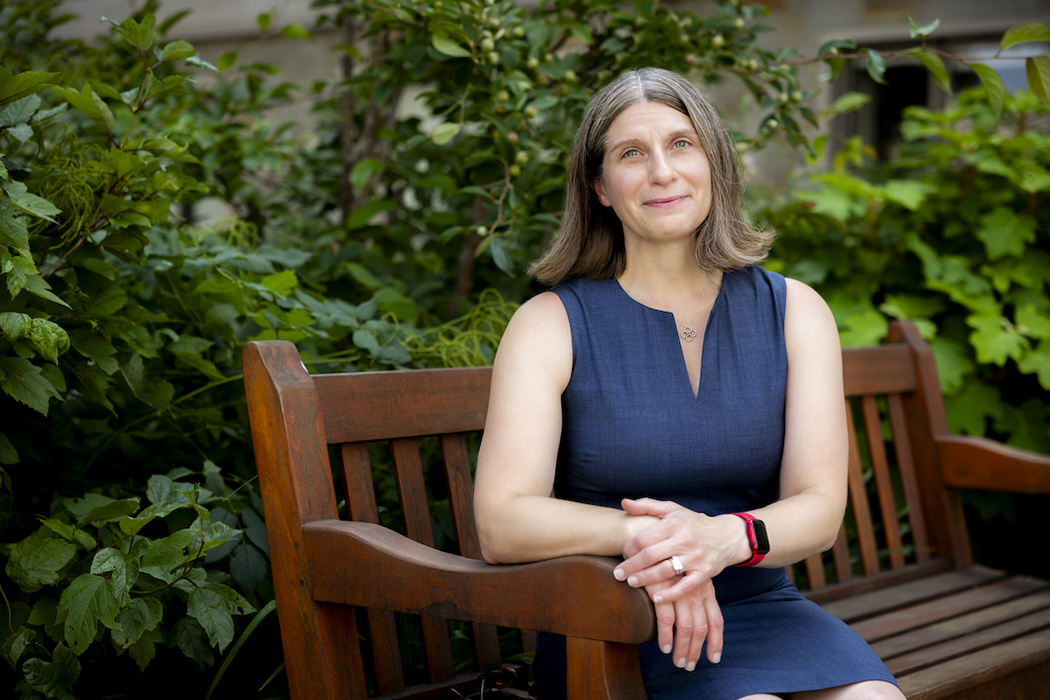
Carolyn Romano. Photo by Caitlin Cunningham for BC Photography.
Carolyn Romano, an assistant professor of the practice at the Boston College School of Social Work, recently created a chatbot that serves as both a role play partner and mentor, moving fluidly between these roles to help students in her Solution-Focused Therapy course better apply the intervention.
Here’s how the chatbot works: The mentor introduces itself, explains the purpose of the exercise, asks about students’ experience with SFT, and prompts them to select a presenting problem. It reviews the intervention steps using the information in its knowledge base—that is, documents and guidelines that Romano uploaded—and instructs the users to begin.
Once the session starts, the chatbot shifts to the role play partner, offering encouragement and reminders as needed. Afterward, the mentor provides targeted feedback on how students implemented the intervention.
We asked Romano how she came to create the chatbot, which she designed with help from the Center for Digital Innovation in Learning AI Test Kitchen.
What drew you to experimenting with AI as a teaching tool?
I was actually pretty ambivalent at first in the most clinical sense of the word. Part of me thought it could be really exciting, and part of me was thinking about the environmental impact and what it means for our brains. What shifted things for me was realizing I could set parameters for how the chatbot operates. That gave me more control from a learning and pedagogy perspective. I could structure how students interact with it, rather than just letting it run freely. That made it feel much more useful as a teaching tool.
How does this tool fit into your broader teaching philosophy?
I’ve always used experiential learning (simulation, role play, activities) as a way to help students move from understanding something to actually doing it. This just feels like another tool to operationalize that purpose. It’s not replacing anything; it’s adding another way for students to practice and build skills. Our goal in the clinical program is to move students from theory to skill, so actually being able to do the work. What I’m hoping is that tools like this help students feel more comfortable and confident, so that when they’re sitting with a real person, they’re not stuck thinking, “What do I say next?” Instead, they can focus on the person in front of them and respond in a more meaningful way.
You’ve emphasized not letting the chatbot “do the thinking.” How do you strike that balance?
The goal isn’t for the chatbot to give answers. It’s to help students think for themselves. If it’s doing too much, then students aren’t actually learning the intervention. So I try to build in prompts and structure that guide them, but still require them to generate the language and make decisions. Learning happens with scaffolding, so in stages. You don’t start by reading complex material; you start with the basics and build up. It’s the same with clinical skills. This tool allows students to practice one piece at a time, like the miracle question, before layering in more complex components. It supports that step-by-step development.
Beyond teaching, what other roles do you take on as practice faculty and how do they connect together?
There’s a lot of formal and informal mentorship. I advise students, write recommendations, and help them think through clinical decisions and career paths. I’m also co-chair of the CYF program, which involves programming, bringing in speakers, and creating opportunities for students to connect. A lot of that includes building in play and creativity: things that are really important for how we show up with clients.
What keeps you energized outside of work?
I hike a lot. That’s a must for me. I also spend time with my dogs, one of whom is a certified therapy dog, and with family and friends. I also think of myself as a social introvert. I can show up and be very engaged, but I need that time to recharge. Making sure I’m rested and have space to decompress is what allows me to show up fully for students.
