

Originally published in Carroll Capital, the print publication of the Carroll School of Management at Boston College. Read the June 2026 issue here.
For Parvati Shallow, four seasons as a contestant on the TV series Survivor were master classes in leadership. Negotiation, strategy, and listening to her intuition (or, sometimes, ignoring it) taught her a lot, but one thing stood out: Becoming a leader isn’t a solo game. It is honed in relationships.
“You can’t fail when you’re building relationships. There is no right or wrong or good or bad, because you’re either winning or you’re learning,” she told an audience of students last fall as part of the Winston Center for Leadership and Ethics’ Brennan Symposium lecture series.

The Winston Center—where students learn, practice, and research skills in leadership and ethics—marks its 20th anniversary this coming academic year. One of its missions is to bring an eclectic variety of leaders to campus to share what they’ve learned traveling different paths. Recent examples have included an admiral, an alumnus ambassador, an NGO founder, two Nobel Peace Prize winners, and Shallow, among others who spoke at lecture programs also including the Clough Colloquium and Chambers Lecture Series.
A recurring theme in the talks is that effective leaders navigate relationships skillfully. Many demonstrate the Jesuit servant-leader perspective, says Winston Executive Director Monetta Edwards.
“When a lot of people think of leadership, they think of the person at the top,” Edwards says, noting that leadership can arise from anywhere on the organizational chart and from unlikely places, like a remote island on a reality TV show. “And for us it’s more about putting service to others above self, about leading with empathy. Those are the values we really home in on.”
Shallow encouraged students to develop their leadership skills as “expanders,” people who offer genuine connection and want to work together, rather than as “controllers,” who need to do things their own way and create an atmosphere of fear.

Parvati Shallow speaking at the Brennan Symposium.
“Communication is not a megaphone; it’s a bridge,” echoed retired four-star US Navy Adm. James Stavridis. “Napoleon said a leader is a dealer in hope—not in fear, not in anger, not in chaos, but in hope. Be that kind of leader. Be that kind of citizen.”
Stavridis, former commander of the US Southern Command and later the NATO Supreme Allied Commander, also cautioned against framing leadership as merely strategy. Globally and personally, it also means being willing to talk to your opponents, even if you don’t see eye to eye, and forging unconventional partnerships.
Competitors, when their interests align, can achieve goals through cooperating, said Nicholas Burns, MCAS ’78, H ’02, P ’09, ’12, former ambassador to China and professor of diplomacy at Harvard University. He spoke about the US relationship with China this past fall. “We’re not enemies. We’re competitors and rivals,” he said, underlining the need to cooperate on issues such as climate change and the next pandemic. To lead internationally, the US must also temper its own internal discord first. “A country cannot be powerful and effective overseas if they’re divided at home,” he said.
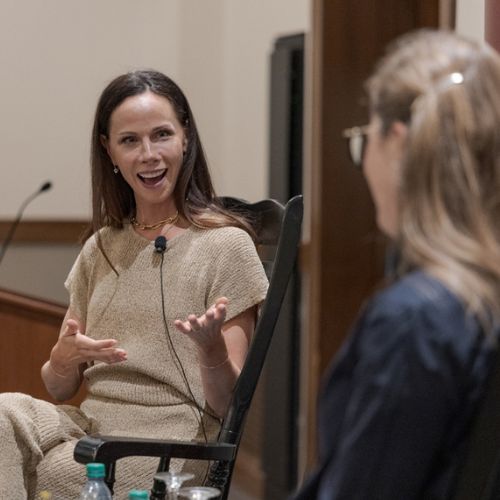
A sense of purpose is an important ingredient in the leader’s inner life—and it tends to grow outside of their safe spaces, said Barbara Bush, former CEO of Global Health Corps, a leadership accelerator that aims to reduce health inequities. “I found it liberating to realize there is no perfect step forward,” she said in the spring of last year. “I’ve grown most when I’ve had hard experiences, or when I’ve been completely out of my comfort zone.”

Nicholas Burns, MCAS ’78, H ’02, P ’09, ’12, speaking at the Clough Colloquium.
For some speakers, following their convictions has meant truth-telling at great personal risk. Journalist Dmitry Muratov cofounded and is editor in chief of Novaya Gazeta, a Russian independent newspaper that reports on government corruption. Journalists at the newspaper have been murdered while covering human rights abuses. A 2021 Nobel Peace Prize winner who spoke a year later, Muratov sold his medal to raise money for children in war-ravaged Ukraine.
Human rights activist Nadia Murad spoke of experiencing the genocide of her Yazidi community in northern Iraq at the hands of ISIS. Many were forced into physical and sexual slavery, herself included. After escaping captivity, she began speaking out, determined to advocate for survivors around the world through her nonprofit, Nadia’s Initiative. Awarded a Nobel Peace Prize in 2018, she said she had to learn that politicians and other powerful people will let you down.
“ “This is why we do the work, for our students to graduate as conscientious and ethical leaders. Our work is really to be part of their journey, their story. ”
“When that happens, you have to keep advocating over and over again,” she said in 2024, “until the actions of one become the actions of many.”
Sometimes leadership is thrust on people. For Liz Cheney, the former Republican representative from Wyoming who spoke in 2023, leadership took on new meaning after the Jan. 6, 2021, attack on the Capitol. Famously breaking with her party, she served as vice chair of the House select committee investigating the attack. She was eventually ousted as a House leader.
Edwards said Cheney showed her overflow audience of students that leadership calls for courage—even when it bumps up against your own expected trajectory. “For our students to see that sometimes you have to take those risks, that was a story I thought was really important,” Edwards says. “How are you going to live the rest of your life knowing you didn’t take that risk?
“This is why we do the work, for our students to graduate as conscientious and ethical leaders,” she adds. “Our work is really to be part of their journey, their story.”