

At a recent event titled "Confronting the Housing Crisis,” the head of the Joseph E. Corcoran Center for Real Estate and Urban Action wasted no time laying out the dire situation of housing in Massachusetts.
“We are in a crisis, as are many parts of the United States,” Neil McCullagh, the center's executive director, declared in a lecture room filled with nearly 100 students, many of them freshmen in the center’s Real Estate and Urban Action Complex Problems class. “The state is currently in a deficit of about 222,000 units of housing, and to cover the amount of housing needed, we would have to be building at a scale that we have never achieved before.”

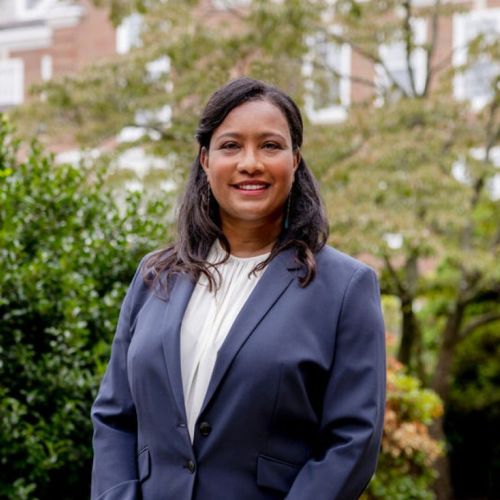
Lisa T. Alexander speaking on September 23.
So what’s the solution? On the evening of September 23 in Hayden Hall, the Corcoran Center welcomed a panel of six housing professionals from sectors ranging from private and nonprofit development to academia and advocacy. McCullagh tasked the panelists with identifying the most pressing issue related to housing in Massachusetts. “As citizens, as people in government, and as people in business, we have to ask ourselves: What has to change?” he asked.
Each panelist offered their personal and professional outlooks on the question. Lisa T. Alexander, a professor at Boston College Law School and faculty director for the school’s Initiative on Land, Housing & Property Rights, shared how growing up in affordable housing, as well as her experiences as a renter, homeowner, landlord, and lawyer representing clients in housing cases have shaped her thinking on the issue. “We tend to view housing as a privilege rather than a right,” she said from a critical perspective. “I think our failure to look at adequate housing as something that every person should have leads us to ignore a lot of problems.”
Alongside Alexander were panelists John Hurley, partner and director of development at The HYM Investment Group; Amy Schectman, CEO of 2Life Communities; Tom Byrne, MCAS ’06, associate professor at the Boston College School of Social Work; Eric Shupin, CEO of Citizens’ Housing and Planning Association; and Tamara Small, CEO of the Commercial Real Estate Development Association of Massachusetts.

Panelists from left to right: John Hurley, Amy Schectman, Eric Shupin, Lisa T. Alexander, Tamara Small, Tom Byrne, MCAS '06
Panel members agreed that Massachusetts should prioritize building more units—a task much easier said than done—but also offered nuanced approaches based on their individual expertise. Those on the development side of housing like Hurley and Small highlighted financial and regulatory barriers to construction, while Shupin argued that affordability is just as crucial as availability.
“Building alone isn't going to solve the affordability problem,” he said, explaining that building homes without thinking of the unmet needs of Massachusetts residents would only amplify high rent prices and other challenges for low-income and vulnerable households. “We need all kinds of housing: market rate, affordable, rental, ownership, public housing, supportive housing with services, multifamily housing, duplexes. We need it all.”
During the Q&A, students took the opportunity to ask panelists about specific acts of legislation passed in recent years and how they might impact the ongoing housing crisis.

Eric Shupin addressing the audience.
One young man asked the panel to evaluate how important the upcoming midterm elections at the local, state, and national levels will be in determining housing policy. “It's hard to imagine anything that matters more,” answered Schectman. “Politics are important at all levels,” echoed Alexander. “Often young people don’t get involved in [local politics], because who cares? But who is selected to be the representative for a town meeting matters a lot in terms of whether things get built and how this gets done.”
Notwithstanding the many formidable challenges, the forum ended on a bright note: public awareness of the need for far-reaching change is growing.
“There is a recognition that we have a housing crisis, and that actually is a really good thing,” said Small, who meets regularly with and testifies before state legislators, adding that the housing crisis has become a fixture of conversation at the highest levels. “We have business leaders, policymakers, and legislators all talking about how we can work together to solve housing.”