


UPDATED: March 9, 2026
Originally published in Carroll Capital, the print publication of the Carroll School of Management at Boston College. Read the June 2025 issue here.
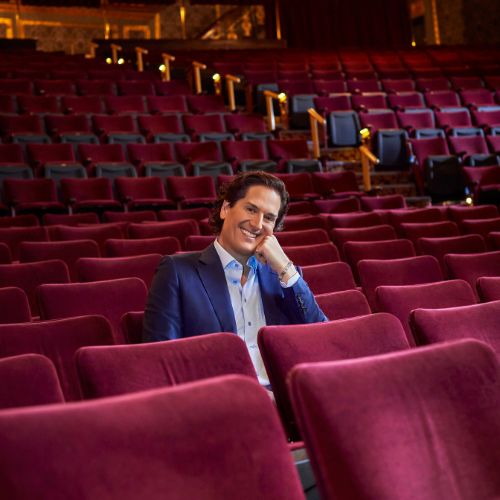
“For most people, the one scientist they’ll interact with over the course of a week is a meteorologist,” says Dave Epstein, LSEHD ’94, MBA ’00. It’s a responsibility that Epstein takes seriously: In a time when even the weather has been politicized, New Englanders have come to rely on the counsel of this meteorologist, horticulturalist, and Boston College alum.
For 33 years, whether on screen for WBZ or WCVB or, more recently, on air for WGBH, online for The Boston Globe, or in his gardening video blog posts at GrowingWisdom.org, Epstein has guided Bostonians through heat waves and snow storms and everything in between. People tune in to him not just for the day’s forecast but also for the wider scope of insight that has become Epstein’s signature.

As part of his multidisciplinary approach, Epstein relates weather to gardening, the climate, bird migration, and more as he strives to answer the broad range of questions his audience is likely to have in any given week. Will my kids’ soccer games be rained out? Is it too early to plant tomatoes? Too soon to take down my bird feeder? Can I finally put away the snow shovel? And what's a polar vortex, anyway?
“We all experience the weather, and we all experience it basically the same way,” says Epstein. And if his readers and listeners come for the quotidian details, they might leave with a better understanding of the atmospheric phenomena that affect all our lives. “I’m giving the forecast, but hopefully there’s a nugget of educational information that you’re getting out of that—something you didn’t know, or something that was clarified."
An unavoidable topic in meteorology today is climate change, and Epstein will discuss it frankly when extreme weather arises. He even spoke out against recent mass layoffs of data-gathering personnel at the National Weather Service, which issues advisories including warnings of weather disasters attributed in part to climate change. Such public-safety alerts are critical “in a world where misinformation is flowing at lightning speed across the internet,” he wrote in the Globe.
Epstein’s comments on such topics tend to carry more weight because he is consistently careful not to sensationalize. “I don’t hype things up. The media often exaggerates, or doesn’t explain well, certain situations, which creates uncertainty and anxiety. So I damn well better be careful when I’m saying, ‘Hey, this is a big deal.’"

What his fellow Carroll School alumni might not realize is that Epstein has always been a bit of an entrepreneur, assembling multiple revenue streams as he’s worked at a variety of part-time but often high-profile gigs, from meteorologist, columnist, and television graphics specialist to high-end landscape designer and college instructor. “I’ve thought of myself as a small, single-entity company, with a lot of irons in the fire,” he says. “It’s allowed me to live a life of vocational diversity."
Epstein—who earned his bachelor’s in biology from Colby College—also worked full-time in quality assurance and product development in the software industry while attending Boston College part-time, first for a master’s in counseling psychology, and then for his MBA. “I still call upon the lessons from BC in a reflective way,” he says. “I have to set aside my ego and think about other people’s hopes and fears.”
He imagines what people want to know and why, whether they’re making travel plans or buying mulch. “I’m constantly trying to put myself in the shoes of the audience,” he says. Those shoes are an easy fit in the case of gardeners: Epstein’s own garden is filled with a bit of “everything,” he says. “Trees, shrubs, native plants, vegetables, pollinators, flowers, a water feature. There’s a lot of color and texture."
For Epstein, who has been fascinated by weather since he was a kid growing up in Maine, meteorology remains both a vocation and no small amount of fun. He says, “Most people are curious about what they’re seeing out their window, and so that’s a cool place to be—to be the explainer that can help them understand the world they’re observing."
.jpg)