

Doctoral Program
Boston College’s Ph.D. in English offers the opportunity to study with nationally recognized faculty in many periods, authors, and critical and theoretical streams. Candidates design their course of study from a wide range of courses, proceeding through a series of exams that culminate in a prospectus exam and the writing of the dissertation.
Overview
The small size of our doctoral program allows for an unusual level of access to faculty and flexibility in designing programs. Four doctoral seminars, four electives, a course in Composition Theory, and an Advanced Research Colloquium are required; the rest of the Ph.D. candidate's work is built around graduate courses, tutorials, and directed research. Each candidate shapes his or her own program to prepare for two sequential oral examinations and a doctoral dissertation.
The Ph.D. in English offers candidates the opportunity to study with nationally recognized faculty specializing in various periods, authors, and critical and theoretical traditions. Candidates choose from a wide range of courses and proceed through a streamlined series of exams, culminating in a dissertation prospectus exam and the writing of the dissertation. We prepare our students to teach, do research, and engage in service in a college or university setting. Given the challenging nature of the academic job market, we now also give our students opportunities to learn about and prepare for other kinds of careers, such as publishing, public humanities, and arts administration.
Upon completing the degree, students should be able to:
- Write academic articles and reviews at the scholarly level in informed, intelligible prose.
- Research, design and be examined on two long readings lists in major and minor fields of literary study of their choosing.
- Demonstrate mastery of an individual chronological and/or national literary field of their choosing.
- Choose or define a question in their chosen field of literary study, and write an effective dissertation on it.
- Teach courses in English effectively, at introductory and advanced levels, in the community college, 4-year college or university setting.
- Publish their research in peer-reviewed journals and present papers at conferences.
- Secure an academic or teaching position.
Program Highlights
All Ph.D. candidates are guaranteed to receive full-tuition scholarships and competitive stipends for five years. The stipend for 2026-2027 is $38,000 for ten months.
We intentionally keep each entering class to four to five candidates to encourage extensive faculty/student interaction and mentoring.
Candidates design one of their oral examinations in consultation with their faculty advisors, and choose from a full range of graduate electives each year.
Our Faculty
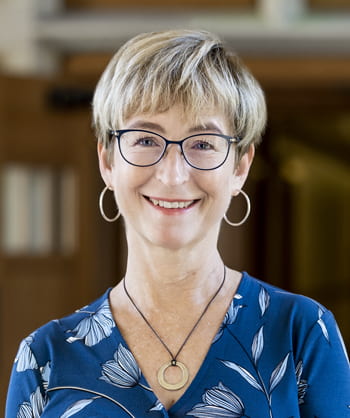
Dedicated to Teaching, Mentoring, and Research
The scholars who make up our graduate faculty have published prize-winning works of scholarship as well as novels, short stories, creative nonfiction, and poetry; contributed articles to leading journals such as PMLA, American Literature, Studies in English Literature, Victorian Studies, Composition Studies, ELH, and GLQ; and been anthologized in Best American Essays and Best American Short Stories. They have won national awards from the NEH, the Guggenheim Foundation, and the National Humanities Center; and edited anthologies, collections, editions, and series in feminist theory, religion and literature, post-colonial studies, and psychoanalysis.
The faculty provide close mentoring at all stages including advising candidates on selecting courses, helping them publish their work, collaboratively designing exams, serving as teaching mentors, and acting as dissertation supervisors and readers.
Students take professionalization seminar once per year in Years 1-3 or until they are ABD. The Proseminar serves as a centralized and cohort-building space in whcih the hidden cirriculum of doctoral study is made explicit and students learn how to prepare for a range of univeristy-basaed careers. The seminar clarifies the program's goals and benchmarks, teaches foundational skills, and offers opportunities for exchange of experiential knowledge among students.
Program Details
Courses
In the first and second years of the program students take a Ph.D. seminar each semester. Each seminar addresses a different topic, is taught by a different faculty member, and includes broadly applicable portable principles and attention to writing as well as specific field content. Recent topics include Making Books, The Unwritten 18th Century, and Imagining the City. In addition, students take a minimum of four graduate electives, or enroll in a tutorial "readings and research" course directed by a faculty member while preparing for an examination. Students may also take graduate courses at Boston University, Tufts University, and Brandeis University.
Language Requirements
Students must demonstrate competency in one language other than English, including Old English and classical languages. This will be evaluated through a two hour translation exam (with the use of a dictionary) or through other means.
Teaching
In their second year students serve as teaching assistants in a course in British or American literature. In the third year students teach one section of each of our English Cour courses: First-Year Writing Seminar and Literature Core. In the fourth year they teach one Core course and one elective in their chosen field. Students recieve instruction, supervision, and mentorship for all their teaching.
Examinations and the Dissertation
Students take two oral examinations. The Field Exam, taken at the start of the second year, is the more capacious in terms of scope. Grounded in a pre-set reading list, it is intended to cover the broad field in which the student plans to apply for jobs (such as Irish Literature and Culture, British 19th Century, American 20th and 21st Century). The Focus Exam, taken at the start of the third year, has a narrower scope and is based on the student's unique interests. Students work from a bespoke reading list that they create in consultation with their advisor; recent topics include Genre Fictions from 1912 to the Present, Transatlantic Modernisms, and Contemporary Irish Women's Fiction. The dissertation prospectus, which serves as a blueprint for the dissertation, is approved by the student's committee at the start of the fourth year. Students begin writing the dissertation in the fourth year while they are teaching and work on it exclusively during the fifth year, when no teaching is required.
A celebratory defense follows submission and acceptance of the dissertation.
Academic Standing and Evaluation of Progress
Doctoral candidates are subject to annual review of academic progress toward their degrees. Each candidate is assigned an academic advisor with whom they will meet regularly and at the end of each academic year, the student is reviewed by the entire graduate faculty to assess and evaluate their performance in coursework, oral exams, and dissertation, as appropriate. All candidates are required to take their minor field exam by the spring of their second year, and will normally take their major field exam by the spring of their third year.
All graduate students are also governed by the Graduate School of the Morrissey College of Arts and Sciences Policies and Procedures.
Resources in the Boston Area

Resources in the Boston Area
Ph.D. candidates have access to the rich offerings for graduate students in the Boston area. Aside from the wealth of local archival resources, candidates participate in seminars at The Humanities Center at Harvard University and in BC’s own Lowell Humanities Series, which brings internationally renowned writers and thinkers to campus. They can also take part in a wealth of courses, lectures, workshops, conferences, and symposia offered at area colleges and universities.
Boston College is also part of a Boston-area consortium that allows students to take graduate courses at Boston University, Brandeis University, and Tufts University. Our students can also take courses at the Graduate Consortium in Women’s Studies at MIT, an interdisciplinary effort to advance research in women's studies. Faculty and students of GCWS are drawn from nine Boston-area colleges and universities.
The BC English department is (with History) the most active contributor to our thriving Irish Studies Program which publishes the Irish Literary Supplement and offers institutional support to the refereed journal‚ Éire-Ireland.
The English department is home to two journals. Religion and the Arts, edited by James Najarian, is a scholarly journal that explores the religious dimensions of verbal, visual and performing arts. Post Road, edited by Christopher Boucher, is a literary journal that publishes fiction, non-fiction, and poetry. Doctoral students can work at both journals in paid and volunteer positions.
How to Apply
The application deadline for the Ph.D. program is January 2. The GRE is not required. Application forms should be accompanied by a personal statement, a critical writing sample of not more than 20 pages, transcripts, and three letters of recommendation, ideally from teachers who have recently evaluated the applicant's current work in the proposed field or area of focus.