

Originally published in Carroll Capital, the print publication of the Carroll School of Management at Boston College. Read the June 2026 issue here.
Paul Romer was months away from winning a Nobel Prize in economics when he decided, “I need to learn how to do software,” as he recalls. So he taught himself code, at 63 years old. Then, after winning the Nobel in 2018 for demonstrating how ideas fuel growth, he reconnected with an old conversation partner, John and Linda Powers Family Dean Andy Boynton. That led to his next act at Boston College.

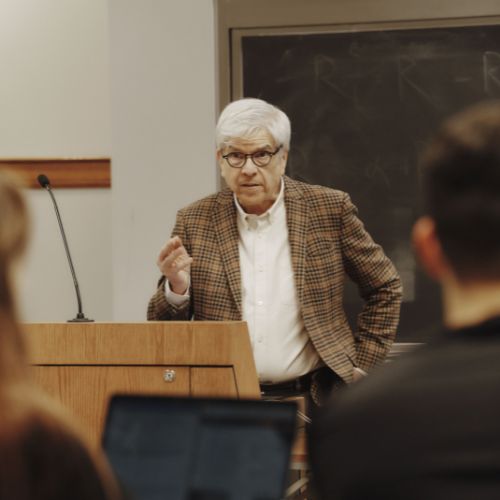
Paul Romer and Sam Ransbotham.
In 2023, Romer arrived in Chestnut Hill as the inaugural Seidner University Professor in what is now the Seidner Department of Finance. He also launched the Carroll School’s Center for the Economics of Ideas, which is developing user-friendly, open-source tools for sharing trustworthy information in the digital jungle.
“You can’t trust an idea if you don’t know where it’s coming from,” says Romer, referring to the challenge of verifying digital communications and weeding out misinformation. The center is creating several cryptographic tools that would help anyone put a “digital signature” on a document, thus verifying the author’s identity. The signature would serve to authenticate research papers, email messages, and even social media posts, while confirming that no one has doctored the content since it was created.
Romer and Business Analytics Professor Sam Ransbotham, who is the David J. Mastrocola Dean’s Faculty Fellow, are testing other tools in the classroom. These include an app that allows beginners to write code instantly, using Python, before undertaking the frequently discouraging process of setting up the program; and another that teaches how a program interacts with the computer’s operating system.
“Coding is becoming very powerful, and very dangerous, partly because of AI-generated tools,” says Romer, who teaches Digital Self-Defense with Python. He adds, “We have to understand it, and we have to run fast to stay ahead of it.”