



If you want to know how to get well next time you’re sick, visit a primary care provider. But if you want to know why you got sick—and why someone else across town did not—visit a public health professional. Their field accounts for what medicine leaves out: the neighborhood you grew up in, the policies that shape your water and air, and the generational circumstances that impact what services and care you can access.
These forces don’t announce themselves in a clinic. But they govern, more than most factors, who gets sick and who stays well. The Global Public Health and the Common Good (GPHCG) program at Boston College’s Connell School of Nursing is organized around that fact. Drawing on the University’s Jesuit commitment to service to others, the program’s renowned faculty are preparing the next generation of public health experts not just to understand health inequity, but to intervene.
Public Health Research
You have to start by thinking of individuals in the context of their communities and relationships and the barriers they face,” says Katelyn Sileo, an associate professor of public health and member of the GPHCG faculty. “That requires trying to address health issues through a multilevel lens that mixes both qualitative and quantitative data to create a rich, broad picture of people’s lives and communities.”

Katelyn Sileo, associate professor
Her flagship project, Family Health = Family Wealth, is funded by a major grant (R01) from the National Institutes of Health and built around two observations: Many Ugandan men resist family planning. Many Ugandan women are not achieving the family planning goals they’ve set for themselves. Are these two facts connected? And if so, how?
Sileo has found that misinformation plays a key role here. “There are a lot of rumors about family planning,” she says. “That contraceptives cause birth defects, cancer, endless bleeding. Unfortunately, people often don’t have a strong relationship with the health system, which could counter these myths.” The stakes of this misinformation could not be higher: many women face high-risk pregnancies, which elevates Uganda’s infant and maternal mortality rates.

Couples participate in Assoc. Professor Sileo's intervention
Sileo’s intervention starts there. To overcome distrust and help prevent unintended or dangerous pregnancies, her team has partnered with local Village Health Teams (VHT), known and trusted community members who have volunteered to serve as liaisons between Sileo’s team and individual households. “VHTs accompany our team door-to-door to introduce the study and ask whether couples would be open to hearing more about the intervention,” Sileo says.
If a couple consents to participate, a study facilitator invites them to a series of group discussions with other couples from the community based on scripted prompts. In addition to correcting widespread misinformation, facilitators frame family planning as a financial matter situated within the context of the couple’s broader hopes and goals.
“Many men see their role as providing for their families and take that responsibility seriously,” Sileo says. “When conversations about family planning are connected to household economic stability—such as the ability to provide food, education, and housing—it often resonates with priorities men already hold.”

Associate Prof. Sileo (bottom right), co-PI Christine Muhumuza (bottom left), and the study team at a health center research site in Uganda
If Sileo’s intervention is effective, more women will be able to access the family planning methods they say they want. Sileo also hopes these conversations will create a more trusting and productive long-term relationship between Ugandan families and the health care system. “That’s why we include and involve local members of the health system,” Sileo says. “Doing so builds capacity and trust, especially when people do experience side effects from family planning methods. Local participation can help strengthen connections between the community and the health system and make services feel more familiar and accessible.”
To verify whether the family planning intervention results in any changes in the timing and spacing of pregnancies, Sileo has included a control group in her research project. “With these couples, we use the same conversation structure, but the sessions focus on education and goal setting related to water, sanitation, and hygiene practices,” she says. “That allows us to better understand whether any differences we observe are related to the family planning content itself, rather than simply the result of participants receiving attention, support, or opportunities to reflect together as couples.”
Associate Professor Katelyn Sileo hopes these conversations will create a more trusting and productive long-term relationship between Ugandan families and the health care system.
“Local participation can help strengthen connections between the community and the health system and make services feel more familiar and accessible,” she says.

Margaret Jiang ’26
BC undergraduates work on campus with Sileo to analyze the transcripts of these sessions and ensure that each conversation adheres to the script and stated goals of the experiment. “Evaluating the transcripts like this is a good way for students to see public health research in action,” Sileo says. “They see how the intervention interacts with cultural norms and social dynamics.”
Margaret Jiang ’26, an undergraduate research fellow with Sileo, says that before her work at BC, she had limited knowledge of how social and cultural forces shape health care outcomes across the world. That changed. “Through this research, I learned a lot about Ugandan culture and global health inequities,” she says, adding that this experience will help inform her own research when she attends graduate school for microbiology.
Public Health Education
Ashley Longacre, assistant professor of the practice, frames the GPHCG program’s ambition in terms of what it asks of students: to move from compassion to action.

Ashley Longacre, assistant professor of the practice
“The Jesuit heritage gives institutional structure and analytic rigor to the pursuit of justice and service,” she says. “Values that are otherwise merely aspirational. We teach students to ask why inequities exist and how interventions work.”
That inquiry draws on a deliberately wide range of disciplines: ethics, biostatistics, epidemiology, communication, global policy, and qualitative analysis. Together, these disciplines give students a vocabulary for understanding health outcomes and a methodology for change.

Shelley White, associate professor of the practice and director of experiential learning
“Boston College is a school that’s committed to the whole student,” says Shelley White, associate professor of the practice and director of experiential learning. In her view, that commitment is evident in two components of the GPHCG program’s approach. First, seniors must complete a yearlong capstone project in which they either assist a faculty member with research or intern at a public health institute in the community, such as Boston Children’s Hospital or the Cambridge Health Alliance. At the conclusion of this project, students write—and often publish—a report on their experience and findings.

Global Public Health students planning their week in the Sonoran Desert

Global Public Health students in the Sonoran Desert, Arizona

CSON students on a service trip in central Maine
The second component is the integration of experiential learning and fieldwork into classroom-based coursework. As part of one course, for example, White brings students to the Sonoran Desert in Arizona for a week. While there, they meet with local organizers to learn about interventions designed to overcome the health challenges faced by local communities whose boundaries do not align with national borders.
Based on this type of fieldwork and classroom opportunities for student-led, case-based analysis, White says that students start to think like professional health officials. “They ask how a community partner’s intervention was designed, how it worked and how it fell short, how theory can help explain what happened, and what can be done better next time,” she says.
Crediting the global health physician and medical anthropologist Paul Farmer, White says, “the ultimate goal is to take a historically deep and geographically broad approach to public health.”
“The Jesuit heritage gives institutional structure and analytic rigor to the pursuit of justice and service. Values that are otherwise merely aspirational. We teach students to ask why inequities exist and how interventions work.”
—Ashley Longacre
Assistant Professor of the Practice
Public Health in the Future
Public health is facing a difficult moment. Federal funding cuts are arriving just as the world grows more interconnected and new threats to population health continue to emerge. This means experts are being asked to do more with fewer resources, at precisely the moment when more is needed.
These circumstances make it the exact time to be educating a new generation. White finds herself drawing inspiration from GPHCG’s students, whose work, in classrooms and communities, represents exactly the kind of resourceful, ethics-driven response the moment demands. “I see them graduate and go onto find new and important ways to address urgent needs and tackle health inequity,” she says.
The problems are bigger than ever, but faculty in the GPHCG program are preparing students to meet the challenge. They know that health is shaped long before anyone walks into a clinic, and that changing it requires more than compassion. It requires evidence. ◆
Leadership Transition
-
This summer, GPHCG enters a new chapter of leadership. Professor Phil Landrigan (Biology) will conclude his tenure as program director, passing the torch to Professor Summer Sherburne Hawkins (Social Work), who currently serves as associate director.

Phil Landrigan
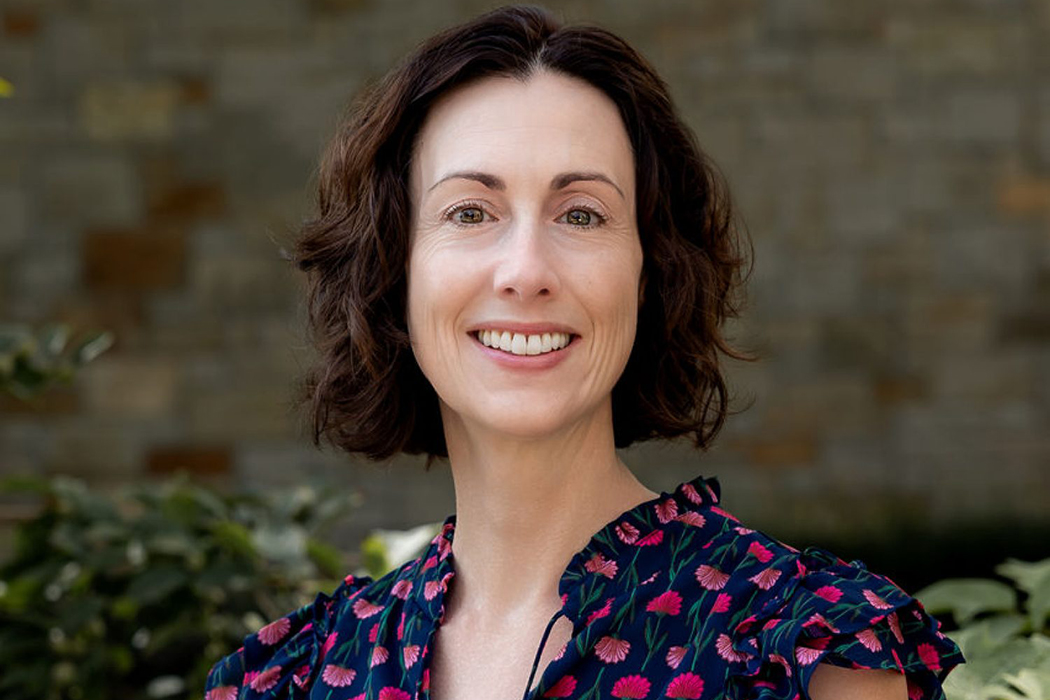
Summer Hawkins