



Giving Up Is Unforgivable
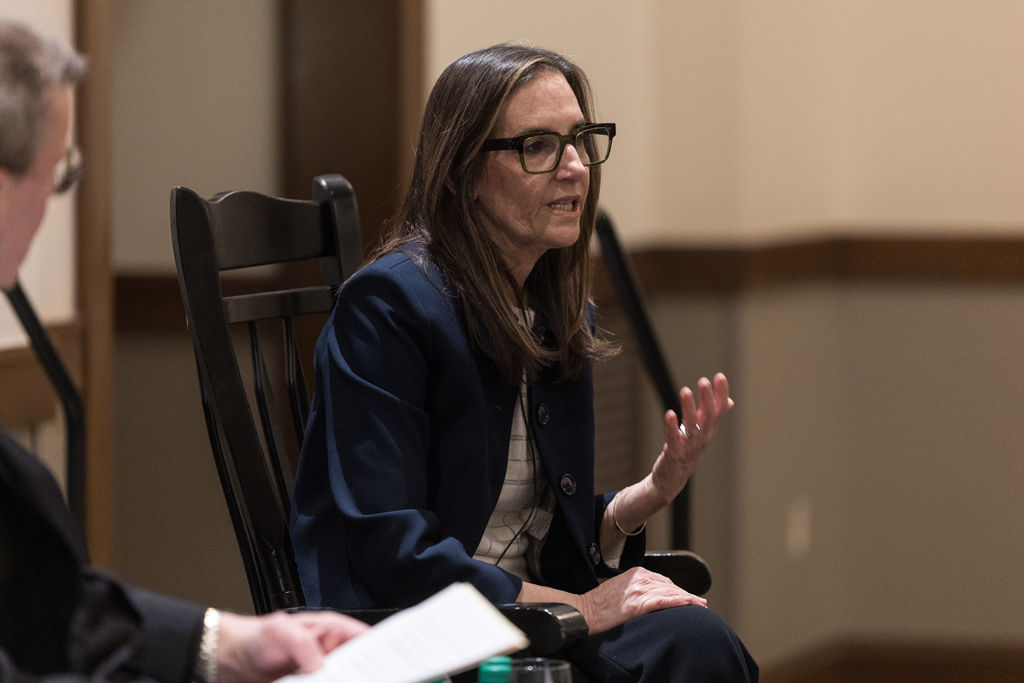
Former U.S. Attorney Joyce Vance warned that as pressure on democratic institutions intensifies, their durability depends on the willingness of public officials and citizens to uphold social and democratic standards.
“Norms are only as strong as the willingness of people to honor them,” Vance said, cautioning that when leaders disregard those standards, “you get atrocious conduct in government.”
Appointed by former President Barack Obama, Vance served as U.S. attorney for the Northern District of Alabama from 2009 to 2017. Now a distinguished professor of the practice of law at the University of Alabama, she writes a popular Substack newsletter, Civil Discourse, on legal and political developments that has attracted more than 620,000 subscribers.
Drawing parallels to post-Watergate reforms, Vance argued the United States may be entering another period when political norms must be enshrined into law to prevent future abuses of power.
“At the end of Watergate, there was bipartisan agreement that norms had to become laws,” Vance said. “We live in another one of those moments.”
Over the course of his two terms, President Donald Trump has tested the bounds of U.S. law, including his efforts to challenge the legitimacy of the 2020 election and the retention of classified documents at Mar-a-Lago—both of which led to criminal cases that were ultimately dismissed without trial and raised questions about the strength of institutional guardrails.
Vance addressed the possibility of renewed prosecution of Trump in those cases.
She argued that while the cases were dismissed without prejudice—allowing prosecutors discretion to repursue charges—the passage of time can weaken evidence, complicate witness testimony, and reduce the feasibility of bringing complex cases back to trial.
“I think it’s extraordinarily unlikely that we’ll see that,” Vance said. “It’s tragic—even for Donald Trump—because he was denied the opportunity to present a full defense to the American people. You might find people who think that those cases could be brought, but I just don’t think they will.”
Vance also pointed to the federal judiciary as both a source of concern and cautious optimism. She described the intense—and at times dangerous—pressures judges face when ruling on politically sensitive issues.
“Many of those judges feel as though they had bullseyes painted on their backs,” Vance said.
Between 2022 and 2025, the number of threats made against judges rose by 40 percent as Trump ramped up criticisms of the judiciary. According to data from the U.S. Marshals Service, there have been 314 investigations into violent threats involving 202 judges since October 2025.
Despite these threats, many judges continue to adhere to legal principles to uphold the rule of law, Vance noted.
“It’s these federal district court judges who understand what it will mean if they rule a certain way, and who do it anyhow, because the law and the facts demand that they do it, and that, I think, is important,” Vance said.
To contrast the executive branch, Vance underscored the accountability mechanisms built into much of the judiciary, with lower federal court judges operating under enforceable ethical standards.
“Every federal judge in the country, court judges—they have ethical obligations, and they take an oath to follow them, and they’re taken very seriously,” Vance said. “A judge in my district was forced to resign because he did something unethical.”
Vance also compared those standards with the Supreme Court, expressing concern that the nation’s highest court lacks an enforceable ethical code.
“If the Supreme Court won’t clean house, someone will have to do it for them,” Vance said. “I think this is terribly short-sighted on the chief justice’s part, not to see that. It’s really sort of a mystery to me.”
The former U.S. attorney also raised concerns about accountability mechanisms within other branches of the federal government—particularly Congress’s oversight of executive agencies—arguing that insufficient oversight can allow problematic practices to germinate.
“The real fault here is with Congress, which has been far too supine,” Vance said.
Vance stressed the importance of civic education in strengthening democratic participation because institutions cannot function effectively if citizens lack a foundational understanding of government.
Adapted from The Heights article by Nikita Osadchiy '29