


Finding the local angle
Panel explores how to bring a global problem to people’s doorsteps.
By Madeleine Mulligan ‘27
Sabrina Shankman, a climate reporter for the Boston Globe, knows her readers may feel disconnected from a global issue like climate change if they see it as a “them” problem. But when they learn about the impact in their backyard, it quickly becomes an “us” problem.
At the second event of the “Climate is Every Story” series on November 12, titled The Climate Crisis Is Local News, Shankman said she focuses on stories near to her readers before bringing up the bigger picture of climate change. A recent story about sewage in the Charles River, for example, drew a strong response from her audience, and its local lens brought to light a larger issue exacerbated by climate change.

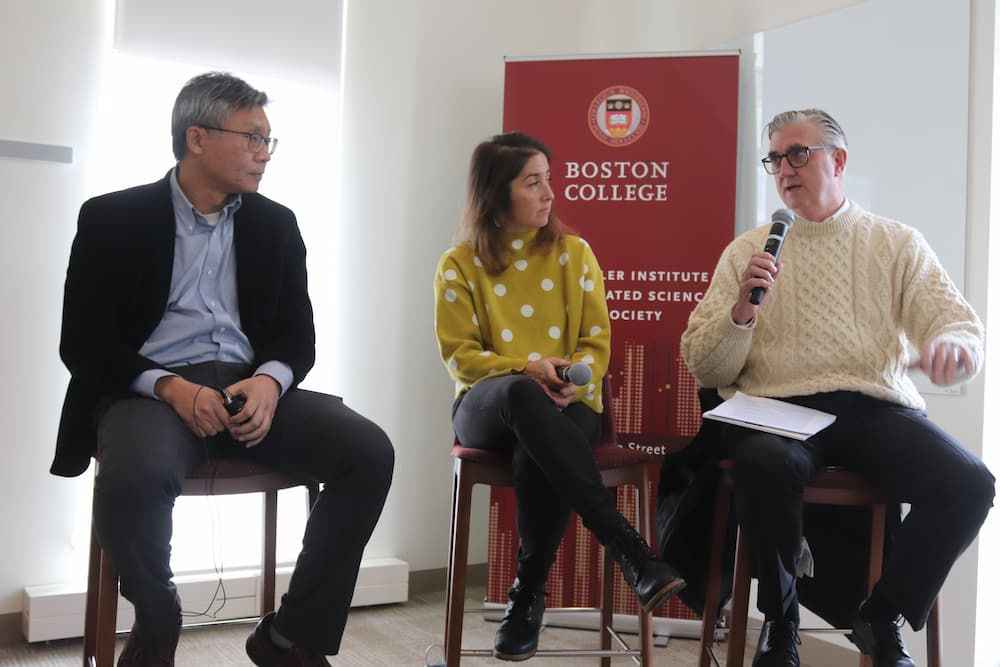
Photo by Jordan Minev-Jones, ’27
“I think there can be a collective exhaustion around thinking about climate change, but there's not an exhaustion about thinking about and reading about the impacts of climate change,” said Shankman. “Whether that's flooding, whether that's gross water in the Charles, those are things that people care about, no matter what.”
The discussion was moderated by Amber Williams (BC ’10), senior editor at the New York Times, and also included BC faculty members who shared how their own research and teaching bring awareness to global issues through local stories. The series is co-sponsored by the Schiller Institute for Integrated Science and Society and the Environmental Studies and Journalism programs, and supported by a grant from the Institute for the Liberal Arts.
Catherine Hoar, assistant professor in the Department of Engineering, explained that she will bring in local examples to provide context for her lectures. When teaching about flooding and urban systems, Hoar explained, she did research with the Charles River Watershed Association on an urban stream in Newton to make the issue relevant and potent for BC students.
Neil McCullagh, executive director of the Carroll School of Management’s Joseph E. Corcoran Center for Real Estate and Urban Action, also uses a local lens to help students understand housing problems. “Our work is decidedly local,” McCullagh said. “When we do projects with students, we try to focus on a local project.”

Photo by Jordan Minev-Jones, ’27
For instance, when discussing the issue of affordable housing in Massachusetts, McCullagh said, giving students a statistic about new units built in the state is less impactful than telling the stories of 13 families currently living in Habitat for Humanity housing.
As the panelists pointed out, climate change is backed by science and statistics, but it is ultimately a human story, and its effects are what matter to people the most. Yi Ming, Institute Professor of Climate Science and Society and professor of Earth and Environmental Sciences at BC, described how he contextualizes climate change in his research. Instead of making climate the entire focus, Ming attempts to bring out the human side of the story, and he reminds his students that their research doesn’t just satisfy curiosity but can impact real peoples’ lives and benefit those who are underprivileged.
His advice to his students: “Don’t generalize too much,” Ming said. “Keep climate change as part of the story, not overtaking everything.”
This advice resonated with the journalists on the panel as well. When taking classes for her masters degree in journalism at New York University, Williams learned that people aren’t swayed by figures and statistics, but rather by emotion. “We want to use the data, but the data itself, the rationality, often doesn't persuade people to change ideas,” Williams said.
Part of the job as a climate journalist is being a science interpreter, according to Shankman. Climate journalists need to be able to read and understand scientific reports, but they can’t expect readers to have this level of expertise. It becomes a job of repackaging the scientific data and jargon in an understandable and engaging way—one that focuses less on the science, and more on who it impacts. Inviting people into the conversation is necessary, and this comes through bringing climate change back to the humans affected.
“The report is a paragraph,” Shankman said. “The person is the story.”