


Schiller's "Fire Weather" book club creates connection and mixed feelings among interdisciplinary group of faculty and students
By Maura Kelly | March 2026
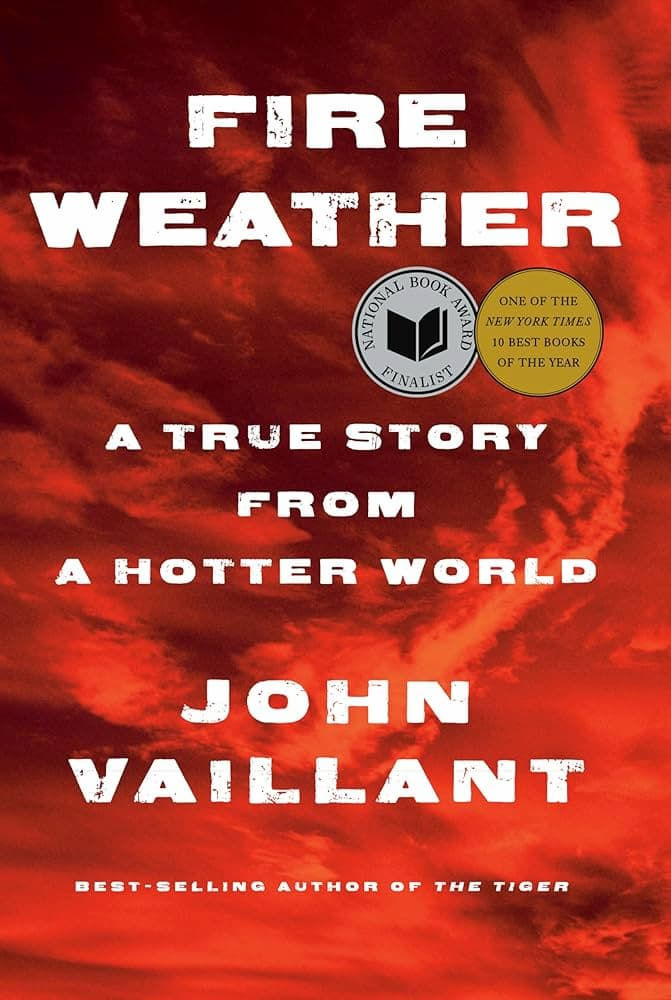
As BC Professor David Deese finished reading the 2023 book “Fire Weather: A True Story from a Hotter World,” he came away with a new understanding of what’s ahead for the planet. “Super fires are going to be a core element of our future on the earth,” he tells SchillerNow. “Fire Weather” centers around the story of the most expensive “natural” disasters in Canadian history, the 2016 Fort McMurray fire in Alberta, Canada—a catastropher that cost Canada an estimated $9.9 billion dollars and forced nearly 100,000 people to flee in the largest single-day fire evacuation in modern history. As the book’s author John Vaillant writes:
A week later, the fire’s toll conjured images of a nuclear blast … there was total obliteration. … One official said, “You got to a place where there was a house and what do you see on the ground? Nails. Piles and piles of nails.” More than 2,500 homes and other structures were destroyed, and thousands more were damaged; 2,300 square miles of forest were burned. … 100m tons of carbon dioxide [was released] into the atmosphere.

What makes the catastrophe all the more head-smacking is Fort McMurray’s raison d’etre: It is home to a number of oil mining and extraction operations, and has played a significant role in the development of Canada’s crude oil industry.
Deese, a research professor of political science who studies the international and comparative politics of energy and climate policies, read “Fire Weather” along with an interdisciplinary book discussion group organized by the Schiller Institute for Integrated Science and Society. The book, written by veteran journalist John Vaillant, was a finalist for a range of prizes, including the Pulitzer and the National Book Award.
The Schiller Institute made it their book club pick not just because it was well-reported and a great read—chosen as a book of the year by The New York Times, The Washington Post, The New Yorker, TIME, NPR, and others. “The topic is so aligned with Schiller's focus areas,” says Gregory Adelsberger, Schiller’s Director of Finance and Operations. He and Kaley McCarty, Schiller’s Assistant Director of Programs, were looking for a good book that would help them bring together a diverse interdisciplinary group. "It was really a win-win-win,” says McCarty. “We were co-sponsoring John Vaillant's talk through the Lowell Humanities series and wanted to find ways to broaden engagement with his visit. Having had success with book clubs in the past, we thought a 'Fire Weather' book club would be a great way to bring people from different roles and perspectives across campus together around his work to connect, while also discussing topics that are so central to our work."
About twenty people across departments—and ranging from full professors like Deese to undergraduates like Magali de la Sancha, an assistant for Schiller—participated in the discussion group, which met twice this winter. “What I was struck with throughout the book was that people knew [for decades prior to today] what might happen [due to climate change],” said Naomi Bolotin, Associate Professor of the Practice of Computer Science, to start off the second meeting. “The consequences were ignored.” The extent to which humanity—and perhaps America in particular—has been mired in denial about climate change alarmed many in the group, including McCarty. “Vaillant does such a good job of representing the psychological limitations we have, as humans,” she said.
Assistant Professor of Engineering Emma Brace commented on how her parents didn’t seem to entirely appreciate the danger they faced whenever there was a tornado warning in her hometown of Topeka, Kansas, saying they would send her down to the basement—while standing on the porch to watch the tornado roll in. “It's very human to look at natural disasters or climate change and have a difficult time understanding the scale, the impact, or that it could happen to us,” says Brace, who aims to propel bioproducts to market with her research on biofuels and related products. “I think there's a gap between research on risk perception and behavior, and actually getting people to change their behavior.”
Nonetheless, the book left most if not all members of the group with a deep appreciation for (which is to say, terror of) so-called fire tornadoes—caused when the incredible heat coming off the flames (which burned at temperatures of 1470 - 1830 degrees Fahrenheit) turned the wind into whirling vortexes of destruction.
Bolotin also mused about whether things would be different today if, in deciding the 2000 election, the Supreme Court had ruled for Al Gore. Deese remarked that prior to the 1980s, Republicans led the way on conservation efforts, and pushed for landmark environmental legislation, as Fire Weather points out. That changed under President Ronald Reagan. “Jimmy Carter put the solar on the White House roof and Reagan took it off,” as Deese said. He also remarked that the current administration’s efforts to keep the fossil fuel industry afloat may not amount too much. “Trump is trying to pay coal companies [or enable them] to stay in business,” he said. “But it’s not like that will save them.”
But Assistant Professor of Law Professor Caroline Cox was less sanguine. In a seminar that she is teaching this semester on climate law, she was just telling her students about the Inflation Reduction Act (IRA). “Part of the theory in passing the IRA was that you spend money on things [like green energy and green infrastructure] and you rev up the market, you create these self-sustaining industries,” she said. But the White House has gone after the IRA—dismantling parts of it and halting others through executive actions, funding freezes, and legislative hits. “That’s created a lot of backtracking,” Cox said.
Similarly, Cox felt uneasy about how Vaillant ended his book—on a hopeful note. He mentioned that amid the destruction left behind by another massive fire that he described (the 2018 Carr Fire in Redding, California) there was a surprising sign of life: A trio of amaryllis flowers were pushing up through the ash when he visited three months later. While acknowledging that Vaillant probably felt obligated to conclude with something cheery, Cox said that we’re not living in cheering times. After all, as she noted, the Trump administration just repealed a crucial part of the Clean Air Act—the 2009 Endangerment Finding, which provides the legal basis for regulating greenhouse gases, due to their deleterious effect on health.
Cox tells SchillerNow why that repeal worries her: “Although it is impossible to say with certainty what the Trump Administration's aim is, it seems likely that the rescission of the Endangerment Finding is a strategic step toward getting the Supreme Court to reverse its decision in Massachusetts v. EPA, which concluded that greenhouse gases are an ‘air pollutant’ and that EPA has the authority to regulate them.” She adds, “If that decision is reversed, it will be exceedingly difficult for future administrations to regulate emissions.”
Many of the book club members attended the March 11 talk that Vaillant gave on campus—an event co-sponsored by the Schiller Institute, the Core Curriculum program, and the Environmental Studies department. Vailliant ended his talk like he ended his book—with a mention of the amaryllis. As he said in person and on the page, the flowers symbolized a concept called “revirescence,” nature’s powerful ability to regenerate. de la Sancha, Schiller’s undergraduate assistant, who also runs Schiller’s student newsletter The Scoop, appreciated the upbeat note. “It actually reminded me of the ending of [the animated film] WALL‑E, when the small plant growing in a boot becomes a symbol of hope and sparks the journey toward rebuilding life on Earth,” she tells Schiller Now. “It offers a counterweight to the sense of hopelessness that can surround conversations about climate change and disasters. It reminds me that even when human systems fail or feel overwhelming, the natural world still has its own resilience.”