


Finding "Mutirão" in the Amazon: A Student Perspective on COP30
By Elleen Kim | January 2026

COP30. The Amazon COP. The forest COP. The implementation COP. With all these potential names and ideas circulating about COP30, I had no idea what exactly to expect as I prepared to attend the first week. Upon landing around 5:00 am in the Belém airport, I instantly felt a veil of warmth and humidity enclose me. (I also slathered on some insect repellent.) While waiting in line at customs, I perused a wall with a picture of an indigenous man rowing on the Amazon River. In wide, white font was the message: “Fossil Fuel Executives, You choose what our children will breathe. Protect the Amazon now.” I entered the city with skepticism-tinged hope for what came next as a Brazilian officer stamped my passport.
After exploring cuisine and wildlife in areas like Combu Island, I first set foot into COP30 via the Green Zone, a section of the conference open to the public that did not require exclusive badge access. Under a focaccia-bread-looking ceiling was a vast array of mostly local and some international organizations sharing sustainability information. The vast majority of the venue was operating in Portuguese, so listening to speakers was often difficult due to the language barrier. However, it was powerful to see many local Brazilians enjoying the VR experiences, listening to local voices, and celebrating COP30. I was happy to see that Portuguese dominated the Green Zone given that the majority of Brazilians speak limited English. A couple of organizations I engaged with there included Deloitte (with C-suite sustainability leaders from various companies), a startup that plants mangrove seeds with drones in the Middle East, a local water provision company, and a biomarket selling locally produced products. I also watched an indigenous theater company perform a deforestation protest with vibrant costumes. Essentially, the Green Zone felt like a public-friendly, more accessible version of COP30 in a very namesake green indoor space.

On the other hand, entering the Blue Zone, the official negotiation space of COP30, required me to show my passport and obtain a badge. Badges are quite challenging to acquire, and I’d heard of Brazilian companies and organizations struggling with badge allocations. I was fortunate to have badge access for 3 days. The Blue Zone was enormous with an area for country and organization pavilions, large rooms for negotiations (which, as a non-party observer, I had limited access to), side event rooms for meetings and speaker panels, and action rooms for more speaker panels. A Portuguese word that echoed through COP30 was mutirão, meaning collective action, and I was able to see that permeate the space through all the events and delegates from all over the world and all walks of life. I met a diverse array of people, from a polyglot indigenous man passionate about youth climate education all the way to the vice chair of the IPCC. My interest in indigenous voices brought me to a large gathering of the COP presidency and indigenous representatives from all over the world speaking out about their local climate grievances.
Another very impactful Blue Zone experience for me was witnessing the U.S. presence at COP30. While the U.S., for the first time, had not sent an official delegation to COP, subnational solidarity shone through the America is All In coalition. I listened to previous U.S. climate negotiators such as Trigg Talley and Sue Biniaz speak alongside Senator Whitehouse of Rhode Island. While the U.S. power void was certainly felt in COP negotiation dynamics, it was comforting to see American representatives from various levels coming together to assert that U.S. climate action is not over just because of the current federal direction.
.jpg)
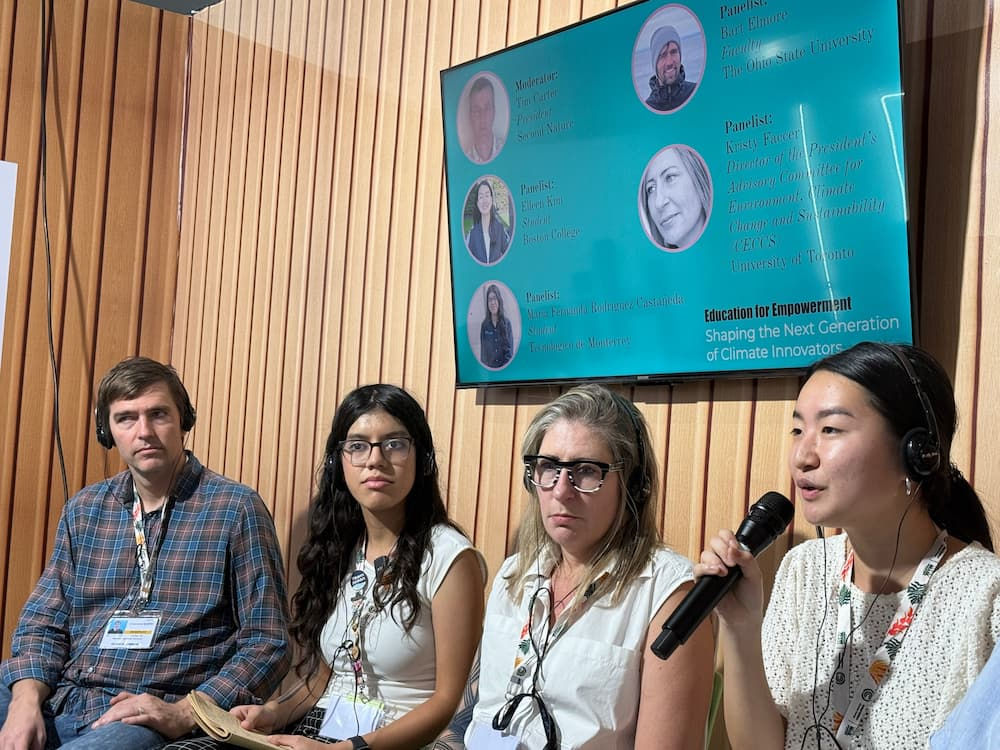
I myself spoke at the Higher Education for Climate Action Pavillion in a panel organized and run by the Schiller Institute in collaboration with other institutions called “Education for Empowerment: Shaping the Next Generation of Climate Innovators.” I spoke with a fellow student sustainability leader and faculty members involved in mobilizing climate action at their universities. This reminded me of the idea of mutirão, a big part of which is multilevel collaboration that engages stakeholders at different levels. At the university level, students and faculty must create innovative new ways of doing things that make sustainability fun, easy, and even rewarding. This same process must occur across different parts of society to allow new sustainable paradigms to reshape the world. COP30 was a place where representatives from different levels of many different societies gathered together to do just that: exchange ideas, learn from each other, and brainstorm ways forward in multilateral community. However, the wondrous diversity of COP also came with the challenging flipside of conflicting opinions and interests blocking tangible action plans like the fossil fuel phase out roadmap and deforestation roadmap that were supposed to come from negotiating tables.
After COP30, critics inevitably asked whether the conference managed to achieve anything of substance. I would argue that having the international spotlight focus on climate action for the short two weeks allowed climate negotiators, activists, and many protestors to make their case before the world within the brief window of two weeks. More importantly, the connections people make at COP blossom into new fruitful collaborations that bring climate innovation. COP30 was a reminder that countries must continue implementing the precedents of the Paris Agreement and increasing their climate ambition to protect a liveable world. The COP30 mascot was the Curupira, a Brazilian folklore spirit known as protector of the forest. It is up to today’s international citizens to become real flesh and blood guardians of the earth through the avenues unique and available to them. COP30 was an opportunity for people with this commitment to gather in one place in solidarity, in bleakness and in hope.