


Making climate connections
Climate reporter Sabrina Shankman has explored the climate beat from the Arctic to her hometown.
By Genevieve Morrison ‘27
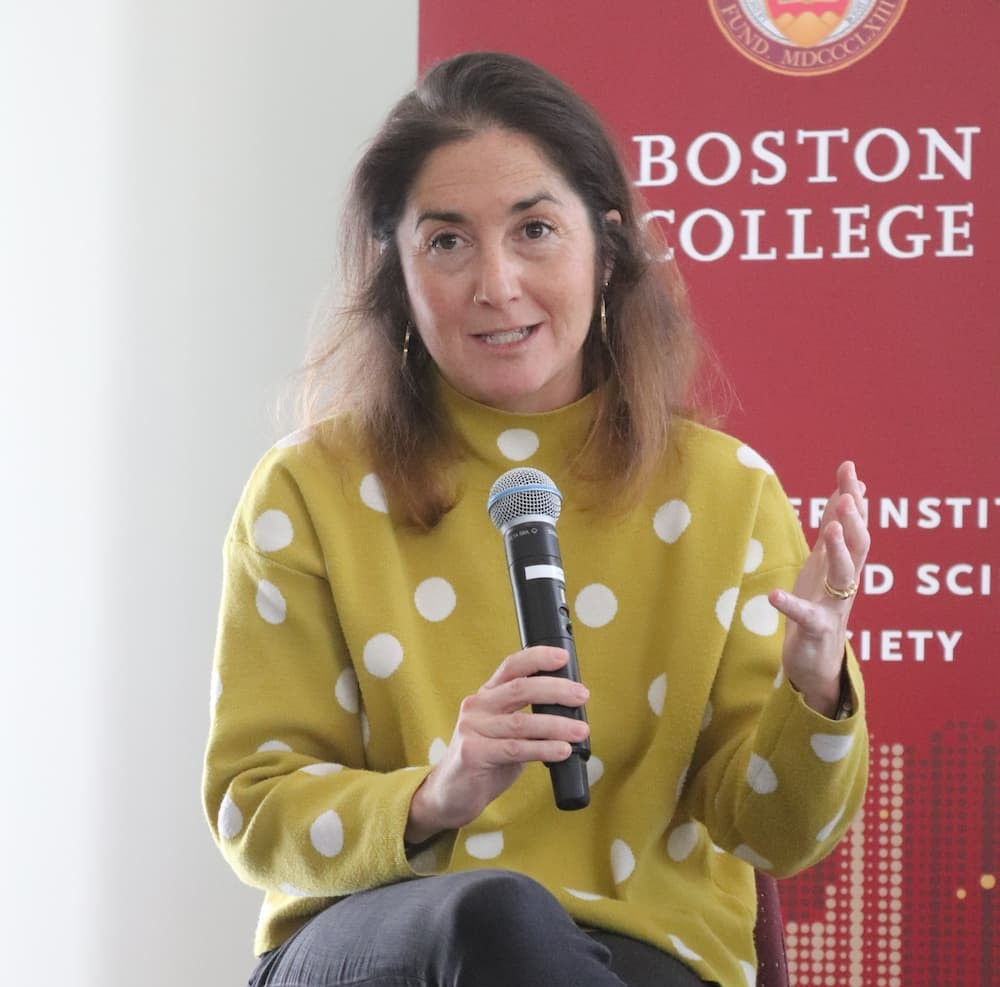
Boston Globe reporter Sabrina Shankman is based in Maine, but her climate reporting has taken her much farther north than home in South Portland. She spent eight years covering the Arctic for Inside Climate News before joining the Globe as the paper’s first dedicated climate reporter. As part of her storytelling, Shankman has interfaced with many facets of the climate issue, including oil workers in northern Alaska, native communities suffering the impacts of fuel drilling, Arctic whaling captains— even polar bears.
In an interview after the Nov. 12 “Climate Is Every Story” event, Shankman reflected on her work as a climate reporter and the path that brought her there.
Your early career took you across the world. One of those places was a Southern California private investigator’s office. What’s the story there?
I had been a graduate student assistant for [60 Minutes legend] Lowell Bergman, an incredible journalist. His son was a private investigator and he needed some help, and I needed some money. It was so much fun. Whatever case he was working on, I would go down to courthouses, pull files, look for people's addresses, that kind of thing. It was not super glamorous, but it was skills that definitely applied to doing accountability journalism—finding out as much information as you could about someone.
More recently, you left Inside Climate News to help launch the Boston Globe’s climate desk. What was it like moving from a newsroom centered entirely on climate to one where it’s a smaller part of the mission?
Coming to the Globe, there was a huge amount of institutional support and excitement about the creation of a climate team. What that meant was that even though we were small, everybody immediately wanted to work with us. It made me feel really supported. My decision to go to the Globe was very intentional. I really wanted to start writing about climate change for a general audience, because people who understand the risks of climate change [already] understand the risks of climate change. But there are a lot of people who haven't really been invited into the conversation yet, and so I wanted to make sure I was more a part of that. There's also something really fulfilling about telling the story in your own backyard.
Four years in, how has the climate desk changed the newsroom?
It's been a successful experiment. We talk about climate change in not just the stories that the climate team writes, but in stories across the board. Once you've planted a flag that we're going to do this with the climate team, I think you've also planted a flag that we're going to do this institutionally. As a result, it feels like if [the climate reporters] are on vacation, if we're sick, if we're busy on projects, climate stories are still getting covered at the Globe in a very serious way, because there are lots of people who are able to do it and who want to do it.
The climate crisis is a big problem. As a climate journalist, how do you negotiate the responsibility to solve it?
When you are a climate journalist, you see climate in every single thing. I can be on the sidelines at my son's soccer game and it's 60 degrees in October in Maine, and I'm like, ‘This is way too warm.’ It can be hard to just enjoy things that should just be pleasant, because you know too much. But in the same way that I feel that we all individually are not responsible for the climate crisis, I feel that as a climate journalist, it's not my job to do everything. My job is to tell the story and try to help people understand and bring them into the fold. Some days I'm successful at it, and a lot of days I'm not, and getting up and doing it again the next day is all you can do.
What’s a climate story you’ve written that felt successful?
One of the last big stories that I did for Inside Climate News before I came to the Globe was in my hometown in South Portland, Maine. I learned one day that there was a legal settlement with a couple of fuel companies that owned tanks that were emitting really toxic, volatile compounds. These were about a 10th of a mile from where my kids went to daycare. And so immediately I was like, ‘Oh my God. My kids are breathing this really dangerous stuff.’ I flagged it for my editor, and I was like, ‘I can't write about it, obviously.’ And they were like, ‘No, you can, you just have to be transparent about it.’ So what we did was a seven-part, first-person narrative investigation, allowing myself to be the proxy for a worried parent. I used my privilege as a reporter to spend my time asking questions about, ‘What is the system that led to this?’ Through that work, I was able to focus on my community, on the people that I knew who were concerned about this. Now there's been some legislative change and some efforts to start monitoring those emissions in my town.