


Schiller’s Case Competition Shows Students How to Bring Business Skills to Sustainability Issues
By Stephanie M. McPherson | May 2026
Having the know-how to solve a problem only goes so far. A number of articles published throughout the 2020s have shown that companies with cross-functional or multi-disciplinary teams have stronger strategic influence, improved growth, and are generally more successful.
“To solve our business problems and achieve our strategic objectives, we need a variety of insights across customer needs and behaviors (marketing, psychology, education), product development (engineering, R&D), financial performance (finance, economics), and we need to tell a great story (history, philosophy, literature),” says Doug Olsen, the Senior Liaison Librarian for Boston College’s Carroll School of Management (CSOM)
“Interdisciplinarity helps us develop those insights and achieve our goals more effectively and efficiently.”
That’s why Boston College’s Schiller Institute and the Boston College Undergraduate Student Government (UGBC) began the Eagles Sustainability Case (ESC) Competition in 2023, to encourage students to practice business development skills within an interdisciplinary framework.
“The more you're used to working with different students from different backgrounds, that will just serve you in the workplace in the future, because you're used to taking all kinds of different ideas not just from your discipline that you are heavily educated in,” says Josephine Xiong, Associate Director for Undergraduate Advising in CSOM and a co-organizer of the ESC.
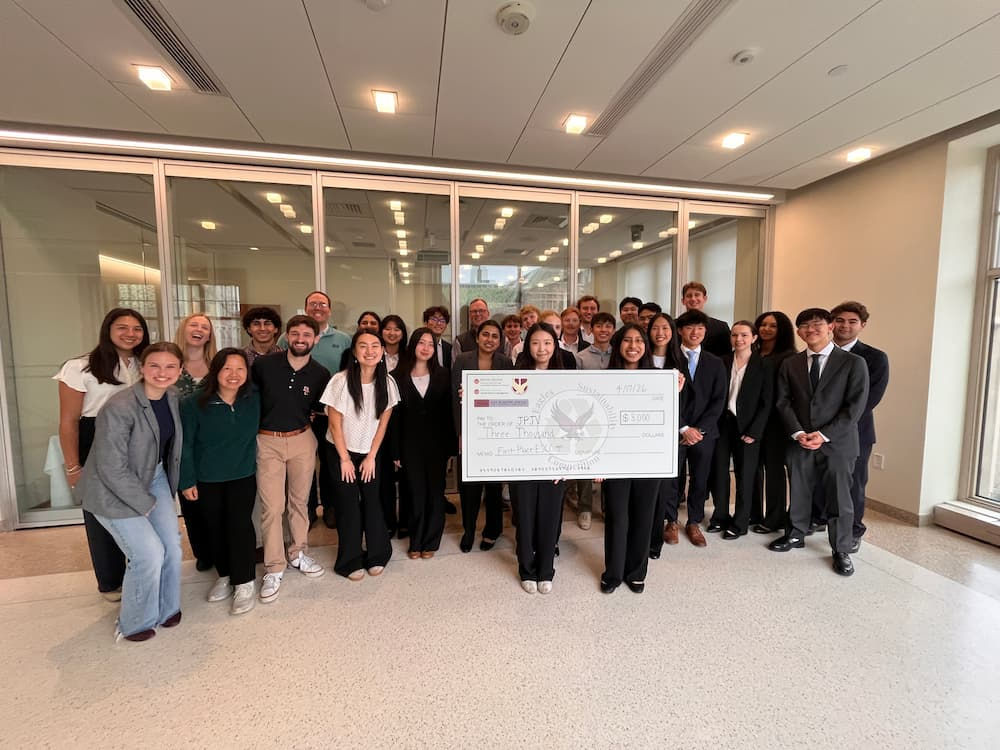
ESC 2026, held on April 17 at 245 Beacon, saw student groups tackling waste issues within the Office of Student Involvement (OSI), which oversees the 450 student-run groups within Boston College.
“Managing all student organizations comes with some key sustainability challenges,” stated this year’s prompt, before citing “supplies inventory management and tracking, waste generated from marketing materials, and the general environmental and carbon footprint of large events like the Student Involvement Fair.”
ESC invites students to form small, interdisciplinary groups to solve a specific sustainability-related problem on campus. The teams present their solutions in front of judges as though to a business board, with the winning team earning $3,000 and the potential to have their idea implemented on campus
.jpg "ESC 2026 Winners")
First Place: JPJV
This year’s first place team was JPJV, made up of sophomores Jaewon Park (Computer Science & Mathematics major) and Jaquelin Vasquez (Finance major). They addressed the wastefulness of flyers wallpapering the campus by designing a fully functional event promotion app. The app lets students flag which clubs and events they’re interested in and pushes notifications to remind them of upcoming events.
“Being able to take a more minute issue on campus and extrapolate it out to such a larger scale was really impressive,” said Andrew Belschner, Assistant Director of OSI.
Park and Vasquez met in the Boston College Consulting Association, one of the hundreds of student-run groups this year’s prompt was designed to help. Vasquez wanted to join the competition to exercise her finance muscles. She connected with Park, who has been taking part in case competitions since high school.
“It's really important to [practice developing] your own business idea because in this AI era, I think it's really important to think it up by yourself,” says Park. “Participating in business competitions would be really helpful for [using] logic…to solve the problems in the world.”
“Hopefully I can land a career in consulting and then know how to stretch my thoughts, how to think outside the box, how to take into account all the factors and really present a structured problem in a coherent way,” says Vasquez.
Over the course of two rounds, the judges chose winners who best presented a feasible, well-researched solution to a clearly defined, specific problem. Olsen was particularly impressed with groups that opened their presentations by declaring their solution.
“I always want answer first. ‘Our solution is going to be this and we're going to tell you how to get there,’” says Olsen, thinking back to his experiences as a consultant making similar presentations. “You have 11 minutes on this executive committee schedule, and you say your thing and they go, ‘oh, now you're down to four minutes.’ So at least you said, ‘Here's our idea.’”
All the students participating in the case competition gain the benefits of such insights from experienced professionals. The ESC organizers encourage students to use any resources available, including sessions with Olsen and Senior Liaison Librarian of Schiller Elizabeth Kuhlman, and to request meetings with any member of the Boston College faculty who could consult on the problem at hand.
“We give a research and information session. We have a library guide that the teams can follow to do some of their research. Interestingly, when I say come to the library and talk to me, not everyone does,” says Olsen.
Olsen was impressed that second-place Green Eagles asked that he connect them with a representative from the library’s existing inventory management system to see how it could be adapted for OSI’s use. Another group soaked up Olsen’s knowledge of creating impactful presentations. Though that group narrowly missed moving onto the finals, they still found value in being part of the competition.
“They said…learning about professional development and some of these tools and techniques that we can apply to classes and professional life afterwards is valuable,” says Olsen. “It isn’t just consulting and finance anymore that does case interviews…telling a compelling story will get you [scientific] funding.”
ESC’s reputation is growing among the students, attractive for how it asks them to use business-relevant skills to address important sustainability issues.
“It's starting to get its own momentum,” says Kaley McCarty, assistant director of programs at the Schiller Institute. “Being able to succinctly put forth your ideas and then defend how you got there and make that clear to other people is a necessary skill no matter where you go.”
A special thanks to the judges: Jesse Swann-Quinn, Associate Director of Environmental Studies; Andrew Belschner, Assistant Director of OSI; Doug Olsen, Business Librarian; Jeremy Evans, Director of MSI; Liz Healy, E&S Alumna.
.jpg "ESC 2026 2nd")
Second Place: Green Eagles
.jpg "ESC 2026 3rd")
Third Place: Guava