


Making the Complex Clear: Why Climate Reveal is the Conversation We Need Right Now
By Kaley McCarty | January 2026
The climate crisis is a challenge that spans every discipline—from physics and economics to education and political science. The Schiller Institute is proud to support Climate Reveal, a podcast that draws on the wealth of knowledge right here at Boston College to bring authoritative climate conversations to our campus community and beyond. By pairing world-class researchers with industry leaders and educators, the show transforms complex climate science into accessible, conversational, and hopeful insights.
The series is the result of a unique partnership between David Deese, Research Professor in Political Science and a long-time Schiller faculty collaborator, and Chris Citorik, Director of the Creative Communication Lab. Together with a talented team of BC student producers, they are bridging the gap between high-level research and the public.
You can listen to all episodes on the Schiller Institute’s Climate Reveal page. We asked Dave and Chris to share the inspiration behind the show, the highlights of Season 1, and what’s in store for the future.
Tell us a bit about yourself and the team behind the Climate Reveal podcast.

DAVE: My background is rooted at the intersection of international politics, energy, and the environment. I joined BC’s Department of Political Science in 1981 after several years at Harvard’s Kennedy School of Government and the Belfer Center for Science and International Affairs. My research and publications at Harvard and early BC years focused on energy, the environment, and international security. While I spent the 1990s balancing teaching with energy policy consulting, my focus eventually shifted entirely to the environment, especially energy and climate questions.
I’ve also been involved with the Schiller Institute in numerous ways since its inception – including leading BC delegations to the UN COPs in Scotland and Egypt and serving as Co-PI and adviser to Schiller faculty grant projects. It was my experience creating Schiller’s first faculty research seminar series, and the Schiller faculty grant results meetings that alerted me to the wide range of deep research and teaching capabilities at BC in energy and climate. These insights, in addition to many connections across the university, made it clear: we have a wealth of faculty expertise right here that we could draw on for a podcast.

CHRIS: I came to BC full time about 3 years ago – when I took on Theory, History, and Practice of Talk Media – after working in the Boston news/talk radio market for 15 years, most recently at WBUR (Boston’s NPR station), where I was a bit of a utility player. Over my five years there, I worked as a senior producer, director, reporter, commentator, and host, mostly for Radio Boston.
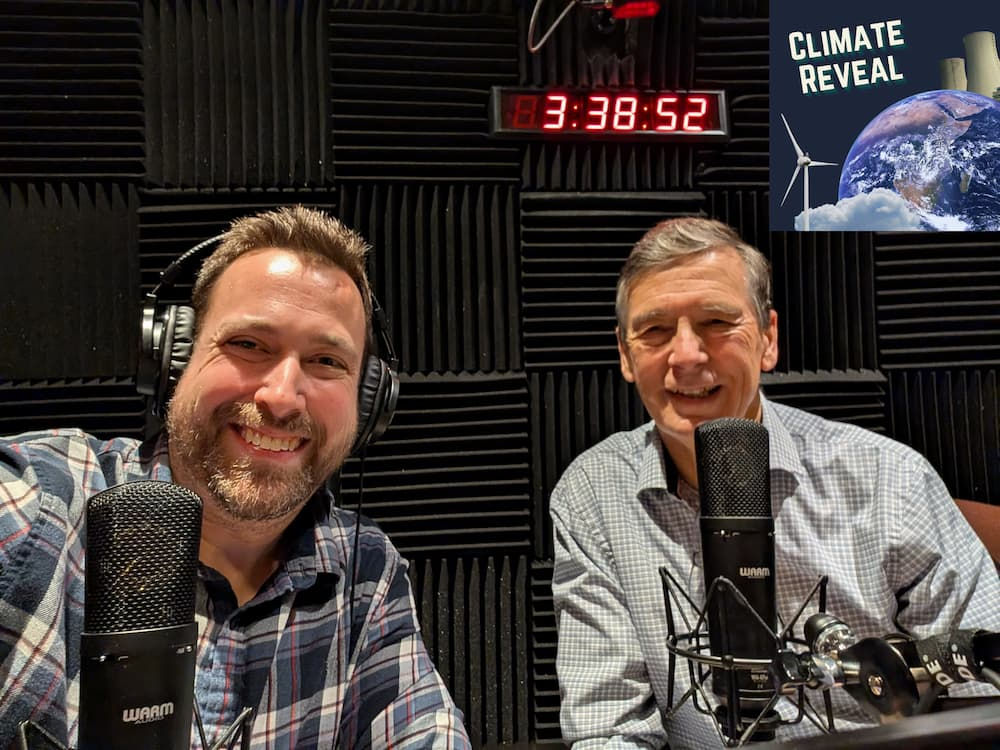
As a former high school teacher, I’ve always loved education, and I quickly fell in love with the BC community. The level of student engagement made the job so much fun, so when a full-time opportunity arose, I jumped at it. I now run the Creative Communication Lab for the Communication Department. We’ve revamped our approach to teaching audio and video production, focusing on mobile, versatile equipment, and have already empowered hundreds of students to find their creative voice. We even record Climate Reveal in the new podcast studio I built in the lab!
Our student producers have also been instrumental. Tessa Burke, our initial producer, helped us get the show off the ground by booking guests and conducting pre-interviews. When her schedule shifted, she connected us with Andrew Fonticoba, who hit the ground running. I think it’s been a great learning experience for both of them to get a sense of what a talk show producer does (hint: it’s anything and everything!), and how impactful that work can be on the final product. They have both been just phenomenal, and there definitely wouldn’t be a show without them!
What was the inspiration behind Climate Reveal?
DAVE: After 50 years in academia and consulting, I wanted to bring my climate and energy insights to a wider audience. The policies of the Trump administrations highlighted the urgent need for authoritative, accessible media to push back with facts. At the same time, ever more US consumers were relying on podcasts for their continuing education and in-depth news. My long-standing connections with MIT’s Center for Sustainability Science and Strategy, my Co-PI role with our chemistry Department Chair for a Schiller grant on Green Hydrogen, and my advisory role for a Schiller grant project on climate education with an Education School Professor all convinced me of the crucial opportunity for a new podcast series on climate change.
CHRIS: I remember clearly when Dave emailed me last January asking to chat about how to create a compelling podcast. Even then, his goal was clear. He was so excited by the research being done on the climate crisis by internationally-renowned experts right here in our backyard, and he wanted more people to know about it and to make that high-level expertise accessible to a wide audience.
How did the podcast come about? How did you start working together?
DAVE: Once I became convinced of the urgency of, and opportunity for, this series, I first approached friends and colleagues at Boston College. I received immediate feedback that the obvious partner would be Chris Citorik. Despite some hesitation to reach out as a complete unknown to Chris, his first response was indicative of how this partnership has evolved – he was positive and enthusiastic from the get-go, and has never backed off from what has grown into a unique and invaluable collaboration.
CHRIS: During our early conversations, I suggested to Dave that he should have a co-host who wasn’t an expert – someone to advocate for the non-expert listener and say “wait, what does that fancy science word actually mean?” Dave looked at me and said, “Yeah, that’s where you come in.” And here we are, in the middle of taping Season 2!
Can you give us a behind the scenes look at season one?
DAVE: Our skills are deeply complementary. Chris brings the "radio voice" and deep broadcast production know-how, while I bring decades of connections in the research, private, and nonprofit sectors. I’ve enjoyed designing the seasons and inviting guests, along with the crucial support and follow-through of our students, Tess and then Andrew. Frankly, it is fun to connect with both long-term and recent connections in the scholarly and research communities, as well as the private and nonprofit sectors.
Chris ensured each episode remained conversational, and knew we wanted to pair researchers with private sector or nonprofit leaders. My work with the Schiller Institute and its faculty seminar series gave us unique access to BC expertise, while my years at MIT’s Center for Sustainability Science and Strategy (CS3) provided a bridge to their leading researchers. These connections across the rich Eastern Mass community have opened many doors for the show.
CHRIS: Like Dave mentioned, we really try to bring two different perspectives to the table for every conversation. So much can be gained by looking at a topic from multiple angles, and Dave has come up with a kind of mind-blowing list of guests to talk to on the podcast. In just our first 8 episodes, we’ve talked to (among others) a nuclear physicist, an internationally-celebrated author, a 7th grade science teacher, a chief meteorologist for a Boston TV station, a pediatrician, a low-temperature physicist who is working with NASA… I mean, how lucky am I to get to talk to all of these folks!
Our very first episode with Eric Fisher and Adam Schlosser set the tone perfectly. Before we even started taping, Adam told us that sitting in the studio with Eric was a childhood dream come true for him! Since then, all of our guests have been so gracious and willing to engage in meaningful conversation.
What is one particular episode or clip from Season One that you would recommend to a new listener who wants to quickly understand what Climate Reveal is all about?
CHRIS: I think one of the great things about the show is that while we do build on our conversations, you really can jump in anywhere and not feel like you’re missing something. That said, our first episode really is our table-setting episode and gives you a great sense of the relaxed, conversational nature of the show.
I’d also flag one of my favorite moments from Season 1: at the end of Episode 3, we had a bonus conversation with BC Professor Cyril Opeil, a physicist working with NASA on an asteroid specimen. He walked us through this incredible mission and had me on the edge of my seat. You can listen to episode 3 on this page.
DAVE: Chris highlighted Episode 1, and I agree. I would also add Episode 2, "Climate Education," because it united one of our own Ed School Professors, Faythe Beauchemin, and a 7th-grade teacher in a superb conversation about how kids learn. Finally, Episode 4 covers a wide range of climate-triggered health threats with two world-leading scholars: Phil Landrigan of BC and Noelle Selin of MIT.
What do you have in store for season two?
CHRIS: More unbelievably interesting guests! David has put together another incredible lineup, covering some fascinating topics (I’m very excited for our conversation about the ocean, for example!). We’ll kick off Season 2 talking with Schiller’s Hanqin Tian and Environmental Studies Director Tara Pisani Gareau – two BC professors who just got back from the UN COP30 in Brazil – to get some firsthand accounts of what that was like, and the ramifications of the U.S. declining to send official representation for the first time ever. Plus, we’re now taking listener questions and feedback at climatereveal@gmail.com!
DAVE: Season 2 will both cover crucial topics we could not fit in Season 1, such as climate adaptation and how to cope with surging electricity demand. We also have two internationally recognized energy and climate scientists – Schiller’s Yi Ming and MIT’s Jennifer Morris – joining us to explain the ins and outs of climate models. We’ll also explore how climate and biological diversity overlap and intersect.
How do you hope this podcast will benefit the BC community and beyond?
CHRIS: In a world full of noise and misinformation, we need to make well-researched expertise accessible to everyone. Our main goal is to have accurate conversations about the challenges we face as a species in a way that invites everyone to the table. It’s the only way to get back to a shared reality based on objective facts.
The show also highlights the incredible people within the BC community. In Season 1, we sat down with faculty from economics, history, biology, health, and physics. It’s a great demonstration of how broad the climate crisis is and how it requires folks from all fields to work together. Getting to talk to these talented individuals has been incredibly humbling.
I’ll admit, I was initially concerned that these conversations would be deeply depressing—that the problem would just seem too big. But actually, the opposite happened! I find myself leaving each conversation feeling more hopeful and empowered to make a difference in my day-to-day life. I hope that is true for our listeners, too!
DAVE: I like Chris's answer a lot. I would only add that the connections made between BC and MIT researchers have been a very important opportunity for us to integrate world-class projects. BC will also clearly benefit from the connections made with private sector and nonprofit leaders who now know the campus and our faculty. Finally, our student workers benefit both intellectually and professionally from this in-depth experience and direct personal connections.