

The Bridge Program
Building off of its success in interschool and interdisciplinary collaboration, Boston College is launching a new academic initiative called the Bridge Program, in which students, known as Bridge Scholars, will probe the world’s great ideas, problems, and opportunities in custom-designed courses and co-curricular experiences that incorporate the perspectives of the humanities, management, and the sciences.
The Bridge Program is open to BC undergraduates combining a concentration or minor in the Carroll School of Management with a major or minor in the Morrissey College of Arts and Sciences, the Lynch School of Education and Human Development, or the Connell School of Nursing.
Beginning this fall, sophomores who opt into the Bridge Program will attend a series of lectures, meetings, and other events across campus, maintaining a portfolio in which they will reflect on their experiences.
In the spring semester, juniors interested in the Bridge Program will take a required course taught by faculty members Jenna Tonn (Engineering) or Michael Smith (Business Law and Society) that will focus on developing the wisdom and habits of mind needed to successfully navigate technological and social disruptions, culminating in a module and final project on artificial intelligence. Bess Rouse (Management and Organization) and Michael Glass (History) helped to design the course. Rouse will serve as an inaugural Bridge Fellow and Glass will offer the junior course in fall 2027.
In the course, students will be introduced to methods and perspectives offered by different disciplines in the humanities, management, and sciences and will practice combining them in collaborative teams to develop skills and reflective practices that will help them make wise and informed decisions throughout their careers.
Those juniors will next year become the first Bridge Scholar seniors, when they will take either a new capstone interdisciplinary seminar or a project-based course. Beginning with the 2027-2028 academic year, the program will span the sophomore, junior, and senior years. Graduating Bridge Program students will be presented with a medal to be worn at Commencement, and their transcripts will recognize them as Bridge Scholars. They and their families will also be invited to a Commencement weekend reception.
“ This process of designing the Bridge Program and now rolling it out is in service of the larger mission and vision of Boston College as a distinctive liberal arts university committed to formative education. ”
This integrated and formative-based approach to learning makes Boston College an outlier in higher education, said Robert L. and Judith T. Winston Provost and Dean of Faculties David Quigley.
“The modern university in many ways is organized to mitigate against this kind of interschool collaboration,” said Quigley. “At most great universities, almost by design, the architecture is meant to prevent this kind of back and forth among students.”
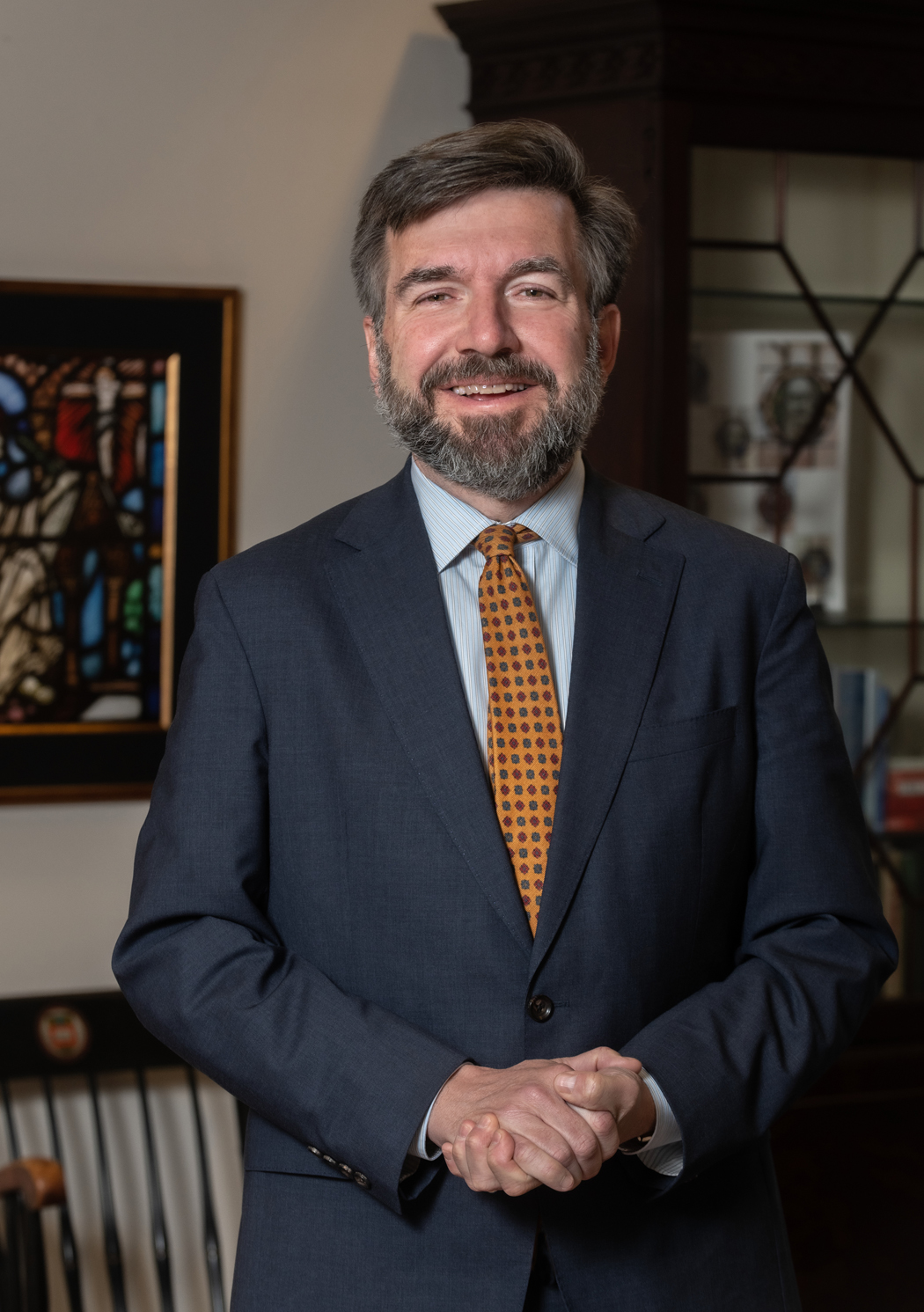
David Quigley (Lee Pellegrini)
And yet, he continued, embracing the cross-pollination of disciplines is at the center of student formation, and of BC itself. “This process of designing the Bridge Program and now rolling it out is in service of the larger mission and vision of Boston College as a distinctive liberal arts university committed to formative education.”
In 2017, Boston College began experimenting with a new approach to classroom learning and student formation that actively encouraged students to take courses outside of their respective undergraduate schools within BC. Students in the Carroll School, for example, were encouraged to take humanities courses, while those in the Morrissey College were invited to sample business classes. The experiment exceeded all expectations, with roughly a third of BC’s 9,400 undergraduates currently pursuing a major or a minor outside their home school.
The University hopes this popular interschool initiative, centered on academic collaboration, will eventually involve the majority of BC students, thereby educating undergraduates who have majored in, for example, finance and theology or in English with a minor in accounting.
Building on that foundation, the Bridge Program will offer courses that will help prepare students to address societal challenges in a time of rapid disruptive change, when wisdom, experts say, is most needed but can be least in evidence as people try to make quick decisions without complete information. University leaders hope the Bridge Program will provide BC students with an advantage by educating intellectually versatile thinkers and problem solvers with an understanding of the humanities, management, and the sciences that job recruiters covet in college graduates.
Quigley said he worked closely during the past three years with Morrissey College Dean Gregory Kalscheur, S.J., Carroll School John and Linda Powers Family Dean Andy Boynton, and Rattigan Professor of English and Institute for the Liberal Arts Director Mary Crane to plan the Bridge Program, which they view as a natural extension of the University’s success in renewing its core curriculum for all undergraduate students.

Andy Boynton (Gary Wayne Gilbert)
"We're very good at innovation here at BC," Boynton said. "We used that capability with our core renewal effort more than a decade ago by designing popular Complex Problem and Enduring Question courses that are taught by senior faculty from various disciplines, and now we are using that innovative thinking with the Bridge Program. It reflects our ability to work together, to collaborate across schools, to think holistically about BC and the best possible educational experiences for our students."
Added Crane, “The Bridge Program is an important priority for Boston College because it offers students a new way to prepare themselves for lives and careers in a complex and rapidly changing world.

Mary Crane (Caitlin Cunningham)
“It will help these students develop ‘Bridge thinking,’ the practical habits of mind derived from integrating the humanities, management, and sciences that will give them an edge in solving complex problems. The program will also help students better articulate the unique benefits of an integrative and formative liberal arts education.”
Fr. Kalscheur said that Bridge Scholars will develop skills that are more urgently needed than ever before. “The world needs this kind of educational effort, especially in this moment where AI is driving the conversation. I think the kind of formation that we are talking about is critical in an AI world, and BC is uniquely positioned to do this. It is grounded in our distinctive mission as a Jesuit, Catholic, liberal arts university.”

Gregory Kalscheur, S.J. (Lee Pellegrini)
The program’s architects say their success in starting the Bridge Program would not have happened without the willingness of BC faculty, including Glass and Christine Rojcewicz (Business Law and Society) who worked with Tonn, Smith, and Crane to design courses and activities and take down some of the walls that have traditionally separated the academic disciplines in higher education.
“We know that college students today have a different set of anxieties from previous generations,” said Boynton. “The Bridge Program will attempt to address these anxieties by increasing students’ aperture about how to see and understand the world, so that they will be more effective leaders, doctors, teachers, and citizens. Managers of any organization whether civic, for- or non-profit, need this integrative ability to succeed, and our faculty are well positioned to provide it.”
The Bridge Program will launch with limited capacity but is expected to grow over time with new faculty hired to meet its needs.
“One of the great satisfactions of the last decade or so has been the recognition from beyond campus that Boston College has something to say about curriculum innovation,” said Quigley. “The Bridge Program is an embodiment of that innovative spirit and our commitment to serve our students.
“It will allow them to take full advantage of the richness of BC’s undergraduate schools—and to think about what it means to integrate the different experiences they have had in their majors, minors, and in the core curriculum—to expand their knowledge and understanding and best prepare them for the challenges that lie ahead.”
To learn more about the Bridge Program, visit bc.edu/bridge.