.jpg)
Qiong Ma Publishes New Article in Nature
Schiller Faculty Affiliate: Qiong Ma
Schiller Affiliate Faculty member Qiong Ma has published research in Nature on a groundbreaking discovery in quantum materials that could lead to faster and more energy-efficient computer memory. Her team identified a way to flip an atomic-scale "switch" within an ultra-thin material, creating a stable, long-lasting memory effect that functions without the need for constant power.
Read more
Explaining a Global Methane Spike
Schiller Core Faculty: Hanqin Tian
Schiller Core Faculty Member, Hanqin Tian, published research revealing how waterways and agriculture contributed to an unprecedented rise in greenhouse gas.
Read more
New Interim Director Dunwei Wang Publishes Research on Polyolefin Blends
Schiller Interim Director: Dunwei Wang
Polyolefins are the most widely used plastics, with an annual global production surpassing 200 million tons in 2023, encompassing two major families – polyethylene and polypropylene. Although these polymers share broadly similar physical characteristics, subtle differences in their structures give rise to the diverse and indispensable applications that define modern consumer plastics. Together, they account for nearly half of all plastics produced, most of which are used only once before disposal.
Recycling polyolefins has long been a formidable challenge. The chemical similarities between polyethylene and polypropylene makes them difficult to separate, yet when mixed, their mechanical properties degrade sharply, producing brittle, low-value materials. This incompatibility has been a central barrier to effective recycling and has motivated intense research efforts worldwide.
A recent study led by Dunwei Wang, Interim Director of the Schiller Institute for Integrated Sciences and Society, in collaboration with Prof. Jia Niu of the Chemistry Department and a chemical engineer at Yale University, Prof. Mingjiang Zhong, introduces a promising solution. Their approach leverages the inherent chemical similarity of polyolefins by installing complementary positive and negative charges onto the polymer chains. When blended, these oppositely charged components form favorable interactions that help to bond the otherwise incompatible polyethylene and polypropylene together, dramatically strengthening the resulting material and overcoming the brittleness that typically plagues mixed polyolefin waste.
Equally important, the functionalization chemistry is driven by light, reducing the energy demands of the process and aligning with broader goals of sustainable materials innovation. This work was recently published in the flagship journal Journal of the American Chemical Society.
BCSSW Faculty Member Wins Wong/Lai Fellowship
Schiller Faculty Affiliate: María Fernanda Piñeros-Leaño
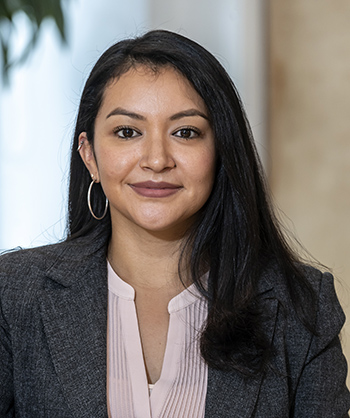
BC School of Social Work associate professor and Schiller Institute affiliate faculty member María Fernanda Piñeros-Leaño has been awarded the inaugural Anita Wong and Wilson Lai Family Fellowship. This award is in recognition of her research focusing on health and mental health inequities among Latin American migrant and immigrant families.
Read more
New frontiers in research on industrial decarbonization
Schiller Core Faculty: Edson Servinini
Schiller Institute core faculty member Edson Servinini has co-published new research examining the effects of global decarbonization. The paper explores how industrial decarbonization technologies and policies interact with the broader economy. Drawing on expanding data resources and policy experience, the study provides large-scale, empirical assessments of decarbonization’s real-world impacts.
Read more.jpg)
Schiller-Funded Grants Bring BC Research to Worldwide Problems
Each year, the Schiller Institute funds pilot-scale projects that give researchers a chance to prove out their ideas before proposing them to larger audiences. These innovative projects also engage students in ways that build on and enhance their education.
Read more
NSF grant awarded to Schiller Core faculty member
Schiller Core Faculty: Jier Huang
Jier Huang has been awarded a US National Science Foundation award for her research on photocatalytic activities of well-defined metal sites on semiconductor support. This collaborative project focuses on fundamental research in catalysis, and provides a versatile platform for training students in the STEM fields.
Learn more
Mapping the Neponset website launched
Schiller Faculty Affiliate: Conevery Bolton Valencius
The Neponset River Watershed Association (NepRWA) recently announced the launch of the Mapping the Neponset website —an interactive digital tour of the Neponset's history created by Boston College students and led by Dr. Valencius. The project was funded by a SI-RITEA grant.
Read more
BC STEM educators continue Charles River Collaboratory project for underserved youth with a STEM summer program in Waltham
Schiller Affiliate Faculty, Avneet Hira, and Schiller Grantee Recipient Mike Barnett
The Charles River Collaboratory Project, funded by a Schiller SI-RITEA grant, continued its mission to support underserved youth by hosting a dynamic summer program in Waltham. Led by Boston College professor Mike Barnett, the youth-driven maker space offered hands-on STEM experiences, from programmable automated greenhouses and AI ethics exercises to tissue-engineering modules, building both technical skills and self-confidence. The program emphasizes long-term participation, peer mentoring, and inclusive access, engaging over 80 students this summer and planning future expansions into areas like fashion engineering and community workshops.
Read more
International symposium reframes computer science education to include character-building
Schiller Faculty Affiliate: Marina Bers
Marina Bers, Professor of Education and Schiller faculty affiliate, hosted an international symposium on reframing computer science education as a human-centered, character-building endeavor. The event, titled “A Palette of Virtues: A Humanistic Education Through Computer Science,” brought together 28 educators, researchers, and innovators from nine countries to Boston College in May 2025.
Read more
Empowering Youth Leadership in Chelsea: From Summer Training to Community Action
Schiller Affiliate Faculty: Becca Lowenhaupt
Adding on to her Schiller grant-funded research with the Chelsea Children’s Cabinet, Professor of Education and Schiller faculty affiliate Rebecca Lowenhaupt and her team organized a one-day workshop in May 2025 to reconnect participants, welcome peer mentors, and engage city leaders. Held at the Chelsea Library, the event aimed to strengthen youth leadership, build community, and inform ongoing research. The workshop was inspired by participants’ strong desire to remain engaged and further develop their leadership skills.
Read more
Research Spotlight Archive
Want to see past research spotlight content? Check out the Research Spotlight Archive page!
Archive