
BC/ISR at HamSCI 2026
BC/ISR’s Teddy Surco and Ted Beach recently took part in HamSCI 2026, the 9th annual Ham SCI Workshop, in New Britain, CT. This year’s theme was “Discovering Science Through Ham Radio.” Beach (aka KA8YRU) presented a talk entitled “New GOES Signal Application for Monitoring Ionospheric Irregularities: A HamSCI Collaboration Vision.” One of his goals is to generate public maps of basic ionospheric scintillation data for amateur radio and scientific use—including citizen science projects with the ham radio community. HamSCI, the Ham Radio Science Citizen Investigation, was started by ham radio scientists studying space physics to fostercollaborations between professional researchers and amateur radio operators.
Pictured above: Top: Beach presenting his talk; bottom: Teddy Surco (left) and Ted Beach (right); photos courtesy T. Surco.

Congrats to new Comm. G Vice-Chair Ted Beach
Congratulations to the new Vice-Chair for the USNC-URSI Commission G, BC/ISR’s Ted Beach. Beach was elected at the recent 2026 National Radio Science Meeting in Boulder, CO. At the meeting, he also presented research results on scintillation measurements with low-cost sensors. Also at the conference, Rezy Pradipta gave a talk on equatorial plasma bubbles, and several other ISR scientists were co-authors onthese and other talks presented at the meeting.
Pictured above: Rezy Pradipta (left) and Ted Beach (right); photo courtesy T.
Beach.

Space Science a the Annual AGU Meeting 2025
The 2025 AGU Annual Meeting took place in New Orleans this year, with several BC/ISR scientists presenting results from their latest research on the ionosphere. Charles Carrano gave a talk on the 2024 Mother’s Day solar storm (aka the Gannon storm) which caused hundreds of millions of dollars in damage just in the US, and Keith Groves discussed an ionospheric experiment using the ALTAIR radar facility at Kwajalein Atoll in the Marshall Islands. Posters were presented by Dima Paznukhov, Rezy Pradipta, Teddy Surco Espejo, Cesar Valladares. David Webb; Theodore BeachSpa and Matthew Proctor co-authored a number of posters and talks, as did the other ISR’ers. Valladares also conveneda session on equatorial plasma density.
Pictured above, clockwise from the upper left: Carrano giving his talk, Paznukhov, Surco, & Valladares out for dinner, Groves giving his talk, and Valladares, Surco, and Pradipta at Pradipta’s poster. Photos courtesy T. Surco Espejo.

Ionospheric Modeling at URSI AP-RASC 2025
Dima Paznukhov and Keith Groves, ionospheric scientists at BC’s ISR, presented their latest ionospheric modelling results from innovative data assimilation techniques at the 2025 URSI Asia-Pacific Radio Science Conference in Sidney, Australia. Groves’ talk, co-authored by ISR’s Alan Hoskinson & D. Paznukhov, described efforts to improve forecasts of the electron density of the background ionosphere. Paznukhov discussed modern analysis tools that several researchers at ISR and AFRL are developing to accurately specify ionospheric conditions more quickly. Paznukhov also chaired a session on the propagation of high-frequency radio waves through the ionosphere. Groves is currently the Chair of URSI’s Commission on Ionospheric Radio and Propagation (Commission G) and led the Commission G business meeting. He is also on the organizing committee for the triennial URSI General Assembly and Scientific Symposium 2026 which will take place in Poland next year.
Pictured above are Dima Paznukhov (left) and Keith Groves (right); photo courtesy D. Paznukhov.

BC/ISR Studies Earth’s Comm-Disrupting Ionosphere
BC/ISR scientists Keith Groves and Teddy Surco spent part of their summer on a small island in the middle of the Pacific to use NASA rockets for studies of structures in the Earth’s atmosphere that disturb radio communications. Groves and Surco are part of the Sporadic-E Electrodynamics (SEED) mission led by Embry-Riddle Aeronautical University (ERAU) and funded by NASA. The disturbances occur in the “E layer” of the Earth’s ionosphere when trace metals such as iron, magnesium, and sodium, condense into dense clouds. These patchy clouds can disrupt the radio signals that communications systems depend on, for example, reflecting and distorting the signals between ground stations and satellites, or those used by air traffic controllers or military operators. The SEED project at ERAU, BC, and Clemson, uses sounding rockets to launch their instruments into the ionosphere to better understand the disturbing “sporadic E” phenomenon. The first SEED launch was June 20 and the second on June 28. While there, Groves and Surco also installed a magnetometer to support additional ionosphericresearch projects at BC/ISR.
Pictured above are Groves (left) and Surco (right); the first launch is shown in the inset. Photos courtesy NASA and Groves, respectively.

NASA’s PUNCH Mission at BC/ISR
NASA’s PUNCH mission, launched in March 2025, has recently released images of its first solar storms known as “coronal mass ejections” or CMEs. When these storms hit the Earth, they can disrupt satellites and power grids, as well as causing the aurorae that many of us have enjoyed seeing the last few years. ISR’s Dave Webb co-leads the PUNCH working groups that will use the new satellites to study the structure and evolution of the CMEs. PUNCH, the Polarimeter to Unify the Corona and Heliosphere, is a constellation of 4 small satellites, each about the size of a large suitcase. Together, they will produce deep-field, continuous, 3D images of the solar corona as it makes a transition to the solar wind. This new perspective will allow scientists to discern the trajectory, speed and internal structure of the solar wind and coronal mass ejections as they move through the inner solar system, improving our understanding of the ambient and dynamic solar wind and their space weather effects. The mission is led by SwRI and UCAR; more information can be found at the team website.
ISR at Space Physics Workshops - June 2024
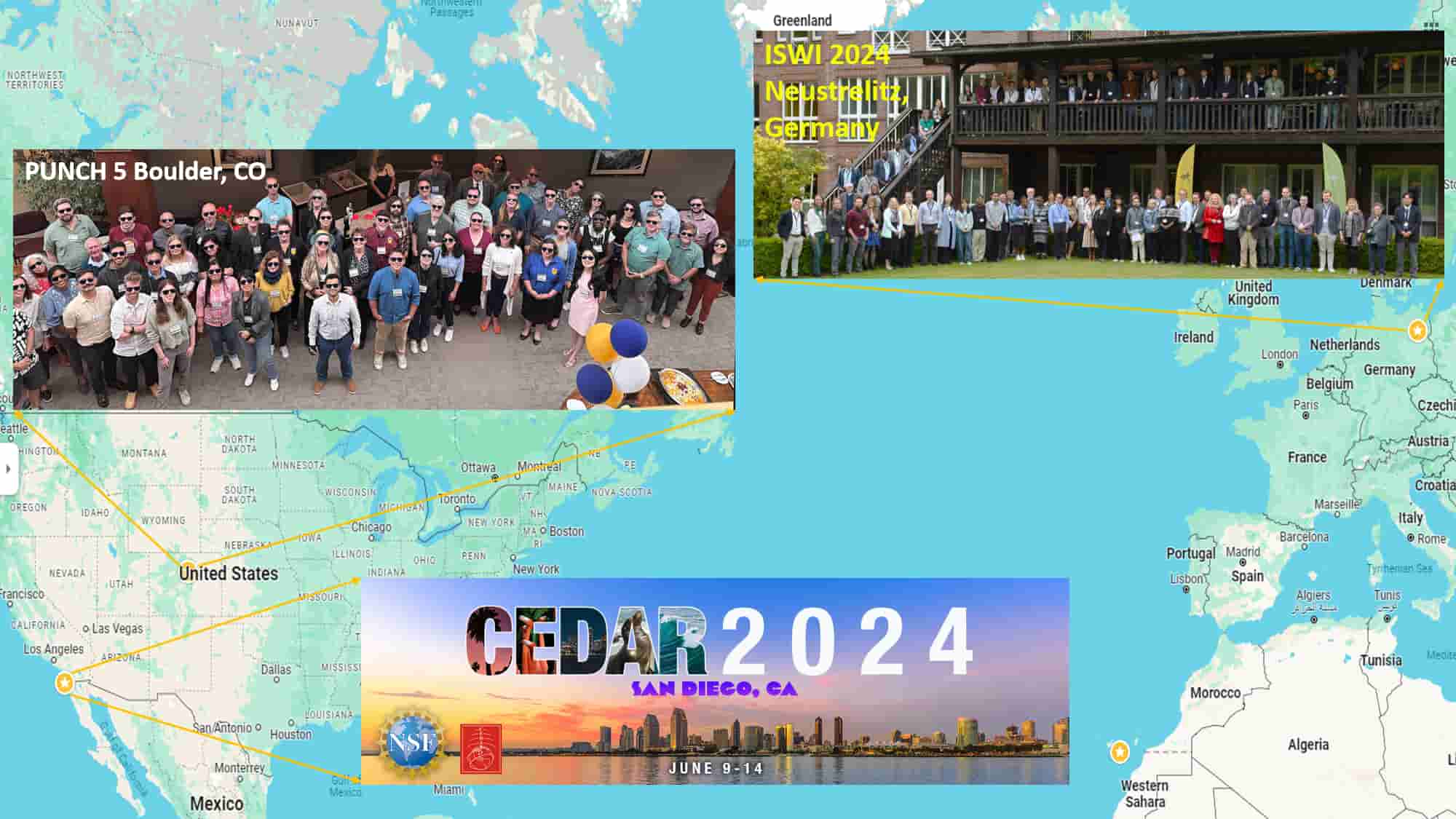
June 2024 saw BC/ISR scientists attending several workshops on space physics research. D. Webb is team lead for coronal mass ejections (CMEs) on the NASA PUNCH mission (Polarimeter to UNify the Corona and Heliosphere), due to launch this coming spring. He attended the PUNCH 5 team workshop in Boulder, CO in June, working on a pre-launch paper on CMEs for the journal “Solar Physics”. R. Pradipta and K. Groves participated in the 2024 CEDAR workshop in San Diego. CEDAR (Coupling, Energetics, and Dynamics of Atmospheric Regions) is an NSF program to investigate the space-atmosphere interaction region, including ionosphere-thermosphere predictability. K. Kraemer attended the 2024 ISWI workshop in Germany, presenting an overview of the SPARTA program, the NASA Space Weather Center of Excellence led by BC/ISR’s K. Groves (Space Weather Research and Technology Applications).
ISR at URSI AT-RASC 2024
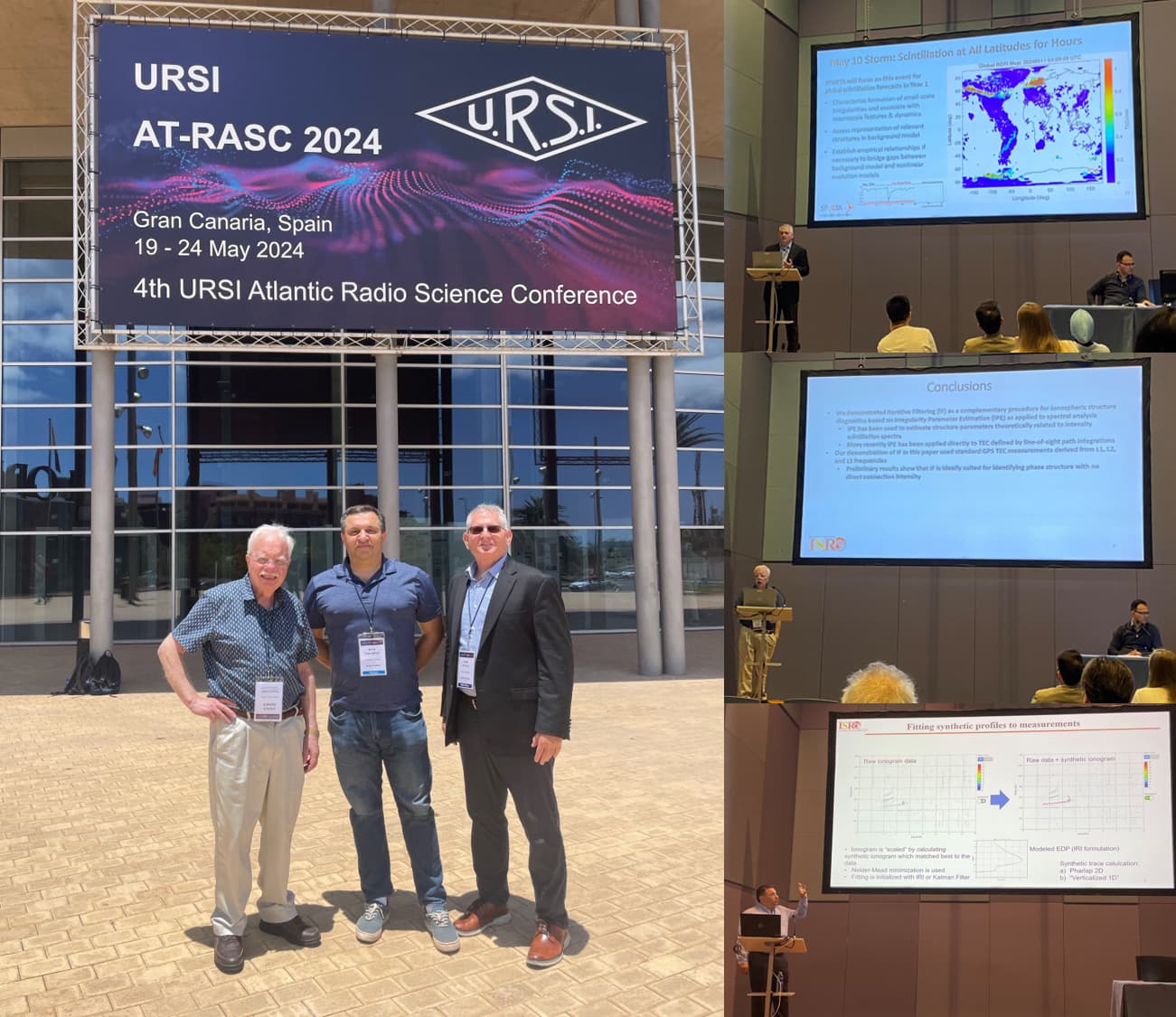
Just after the biggest geo-effective storms of the current solar cycle hit the Earth on May 10 (aka, the Mother’s Day storm), BC/ISR scientists K. Groves, A. Hoskinson, D. Paznukhov, & C. Rino presented their ionospheric research at the 2024 URSI Atlantic Radio Science Conference. Rino, Paznukhov, & Groves (left to right in the photo) traveled to Spain for the conference, while Hoskinson presented remotely. Their research provides insights on how such storms affect the ionosphere and how that can disturb satellite communications and navigation systems. Groves is the current chair of URSI Commission G, Ionospheric Radio and Propagation and supported board meetings and tutorials for the conference.
Photos: left panel shows Rino, Paznukhov, & Groves (left to right); right panel shows Groves, Rino, & Paznukhov presenting their work (top to bottom)

ISR Activities in April 2024
April 2024 saw members of BC/ISR traveling across the country to catch the total solar eclipse, including Vermont, New York, and Ohio. Closer to home, we provided eclipse glasses & answered questions from BC students and staff in the BC Law parking lot and on main campus where it reached ~93%. ISR’s Newton-based ionospheric monitoring equipment detected signal changes in the data due to the eclipse that are currently being analyzed by D. Paznukhov. Also in April, ISR postdoc Teddy Surco Espejo (top left) went to Manila, Philippines for the UN/Philippines Workshop on the Applications of Global Navigation Satellite Systems (GNSS), where he gave a talk on his research on using ROTI to estimate ionospheric scintillation, co-authored by IRS’s Charles Carrano & Keith Groves. Scintillation can cause errors in GPS signals, for example, and compromise the accuracy of positions and timing. Associate Director Keith Groves attended the 2024 Space Weather Workshop in Boulder, Colorado, presenting an overview of SPARTA, BC/ISR’s new NASA Space Weather Center of Excellence, which is also focusing on improving scintillation predictions.
Image credits: top-left & center: T. Surco Espejo; lower-right: SWW 2024; ionospheric data: D. Paznukhov