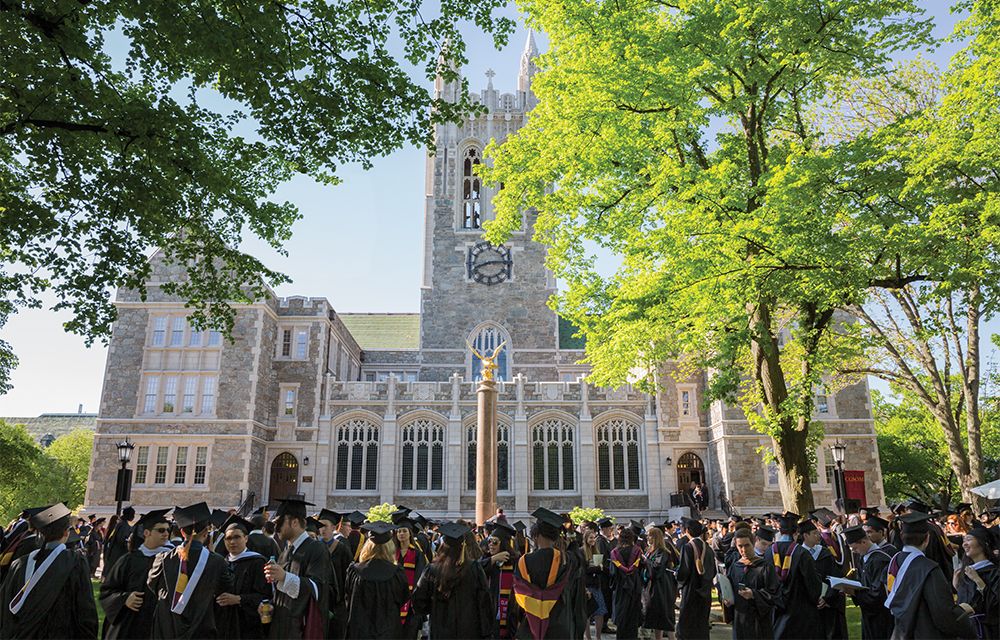
This handbook contains information on the graduate degrees offered by the Department and is designed to assist students in planning their course of study with the help of their advisors.
Graduate Advisors
Once admitted, each student is assigned an advisor, who plays an essential role in the graduate student’s academic life by helping him or her design a program tailored to appropriate professional goals, develop areas of strength, and remedy weaknesses. Advisors serve as students’ advocates within the University, track their progress through degree programs, and provide general professional advice. To help build a solid intellectual and professional profile, students are encouraged to study with as many professors as possible in the Department.
All graduate students must meet with their advisors during the first week of classes each semester, as well as during the periods of pre-registration (November and April), to discuss course selection and to review their program of study. Unless circumstances require a change, students work with the same advisor throughout the entire M.A. program, or, in the case of Ph.D. candidates, until they have selected a dissertation director.
Director of Graduate Studies
In conjunction with the Chair, the Director of Graduate Studies is responsible for the overall coordination of the graduate programs, from the process of admission to the completion of degrees. He is a resource person for graduate students and faculty and is available for consultation throughout the year.
Graduate Committee
Consisting of one faculty representative from each of the three departmental sections, the Director of Graduate Studies (committee chair), and the Chair, the Graduate Committee serves as a liaison between the University and the Department’s graduate students. It resolves questions involving individual students with regard to the circumstances under which degree requirements are met (transfer of credits, for example) and is responsible for the on-going development and execution of improvements in the graduate program.
Graduate Secretary
Graduate students should speak with the Graduate Secretary (617-552-3820) to make appointments with the Director of Graduate Studies, to schedule translation and degree program examinations, and to obtain degree program reading lists.
Master of Arts Programs
Admission Requirements
Candidates for all Master of Arts programs should have an undergraduate major or its equivalent in the appropriate field, including advanced composition and surveys of the pertinent literatures. Since all courses in the Department are conducted in the target language, students are expected to enter the program with sufficient oral and written proficiency to perform with ease in the linguistic environment.
Conditional Admissions
Applicants whose preparation does not meet the above requirements, but who show exceptional potential, may be admitted to a Master of Arts program on a conditional basis. The regular candidacy of such applicants will be formally evaluated once the student has completed four courses (12 credits). Applicants with specific deficiencies may be asked to take one or more appropriate courses in addition to the ten courses (30 credits) required for the Master of Arts.
Special Students
Under certain conditions, students may be admitted into individual graduate courses without having been accepted into a degree program. This may occur when the application deadline or the prerequisites for graduate study cannot be met in time for general admission, or when an applicant does not wish to work toward a particular degree. Special students who apply later for entry into degree programs may transfer up to 12 credits earned in the Department (grade of B or better) toward their degree requirements, with the approval of the Advisor and the Director of Graduate Studies, and in consultation with the students' professors.
M. A. Admission Procedures
A complete application, to be submitted directly to the Graduate School of Arts & Sciences, consists of the following:
- Official transcripts of all undergraduate study
- Two letters of recommendation
- A statement of purpose elucidating the applicant's professional objectives
- A writing sample in the target language (often a paper written during the senior year of college)
The annual deadline for application to the Graduate School of Arts & Sciences is January 15. Students are normally admitted only for the Fall semester.
Financial Assistance
The following forms of financial assistance are available to students in the Department: Teaching Fellowships, Graduate Assistantships, and two Fellow-in-Residence positions. There are also several fellowships for study abroad. Appointments and awards are competitive and are based on the candidate's academic background and experience. For those seeking Teaching Fellowships, an interview is required. Students who wish to obtain information about the University's financial assistance or who are interested in government grants should contact the University's Office of Student Services.
Master of Arts Degree in
French, Hispanic, or Italian Literature and Culture
Course Requirements
- 30 credits (i.e., 10 courses) in Romance Languages & Literatures courses.
- M.A. candidates may receive a maximum of 9 credits for courses taken in languages/literatures other than the primary language/literature of study, including courses on literary theory, pedagogy, and linguistics. Included in this limit, and with the approval of the Graduate Studies Committee, up to 6 credits may be earned from courses in related areas of study.
- Distribution Requirement: Each student in the French M.A. Program must take at least one course from every area of the curriculum (Medieval, Early Modern, 18th Century, 19th Century, 20th Century). The fulfillment of the Distribution Requirement is to be overseen and verified by the Faculty Advisor.
- Distribution Requirement: Hispanic Studies students must take a minimum of 9 credits in Peninsular Spanish and 9 credits in Spanish American Literature.
- Entering M.A. students in French and Hispanic Studies are strongly encouraged to take RL 704, Explication de textes, and RL 901, Advanced Textual Analysis in Spanish, respectively, during their first year of graduate study.
- Students wishing to register for Consortium Institution courses must secure permission to do so from the head of their language section the semester before actually enrolling.
Each of the three language programs has its own mode of evaluating progress during the second year of the M.A. program.
- A research project and oral presentation (French)
In addition to the successful completion of course work (10 courses / 30 credits), each student must complete an Independent Research Project and Presentation. The Project will result in both a Research Paper (of some twenty-five pages in length) and an Oral Presentation and Discussion (of thirty minutes maximum). The Project will represent a significant revision or extension of a paper that has been written in one of the Graduate Courses taken by the student during the first two semesters of study. Each student, in consultation with the Faculty Member whose course is at the origin of the Project, will define a precise topic for the Project and Presentation by June 1 of the first year of study. Work for the Project will be pursued over the summer between the first and second years. The Research Paper resulting from the Project will be submitted for review to the Project Director by September 15 of the third semester of study, and copies of it will be distributed to the Faculty of hate French Section by October 15. A Presentation of the Project to the Faculty of the French Section (ten minutes), followed by a short Discussion (twenty minutes), will be scheduled after November 1. The Independent Research Project will be graded Pass/Fail.
- A student-led conversation on literary topics (Italian)
In addition to the successful completion of coursework (10 courses/30 credits), each student must lead a conversation on literary topics with a panel comprised of three members of the Italian faculty. This conversation will be based on the student's coursework and will take place in mid-March of the second year of the program. depending on the student's previous experience of Italian Literature, coursework may have to be supplemented with additional reading suggested by the faculty. This will be graded on a Pass/Fail basis.
- An oral, comprehensive examination (Hispanic Studies)
In addition to the successful completion of coursework (10 courses/30 credits), each student must take an oral, comprehensive exam with a panel comprised of three members of the Hispanic Studies faculty. The exam will be one hour in length and based on the student's coursework and the Department reading list. The exam will take place in mid-March and be graded on a Pass/Fail basis
Incompletes
Only under extraordinary circumstances may a student request an extension to complete course work after the date set for the course examination. In accordance with Graduate School of Arts & Sciences policy, an incomplete (I) automatically becomes an F six weeks into the semester following the semester in which the course was taken. The grade of F becomes permanent if course requirements are not completed within one calendar year of the conclusion of the course.
Student Standing
Students must maintain an average of B or better in all graduate courses to remain in good standing. No academic credit is granted for courses in which a student receives a grade of F. A student who receives a grade of C in more than 10 semester hours of class work, or an F in more than 8, may be required to withdraw from the University. In addition, no student may carry more than two incompletes at one time. Only students in good standing are eligible for financial assistance, including Teaching Assistantships, Graduate Assistantships, and Fellow-in-Residence positions (Maison française and Casa hispánica).
Time Limit
The Graduate School of Arts & Sciences stipulates that a student must complete all requirements for the M.A. degree within five consecutive years from the date of her/his acceptance into the program. Time accumulated as leave of absence will normally be considered a portion of the total time limit for the degree. Leaves of absence are not usually granted for more than two consecutive semesters. Despite the University's five-year time limit for finishing the M.A. degree, the Department fully expects students to complete all requirements within two years of entering the program.
Interim Study Requirement
Students who have finished their course work must register each semester thereafter for RL 888, Interim Study, until they have satisfied all degree requirements.
Second Language Study
Since all Ph.D. programs in Romance languages require knowledge of at least two foreign languages, students contemplating doctoral study in this area after receiving their M.A. degree are strongly urged to acquire a second Romance language as soon as possible in their graduate career. Students who pass the Department's translation examination in a second language will receive official recognition of this fact.
Reading Lists
Reading lists for each language are available online:
Master of Arts
- French (There is no reading list)
- Italian (Coursework may be supplemented with additional reading suggested by the faculty from this list)
- Hispanic Studies
Doctor of Philosophy
- French
- Hispanic Studies
- Plan II (To be determined in consultation with faculty)
Master of Arts Degree in Teaching
French or Hispanic Studies
The Master of Arts in Teaching (M.A.T.) program is administered through the Lynch Graduate School of Education in cooperation with the Department of Romance Languages & Literatures. It requires admission to both the Lynch Graduate School of Education and the Department of Romance Languages & Literatures. The program provides certification and continued professional development for primary and secondary school teachers of French and Spanish.
Courses: a minimum of 30 credits with an average of B or better, to include:
- 15 credits in the Department of Romance Languages & Literatures, focusing on French or Hispanic Studies, distributed as follows:
- 9 or 12 credits in courses on literature and culture.
- 3 or 6 credits in advanced textual analysis (either RL 704 [French] or RL 901 [Hispanic Studies]), or graduate courses in linguistics or phonetics.
- A minimum of 15 credits in the School of Education: students are strongly urged to include RL 597/ED 303, Foreign Language Pedagogy, as one of their education courses.
Candidates seeking certification by the Commonwealth of Massachusetts must meet state subject matter requirements for their area of specialization, and must attain required levels of language proficiency in their target language. In addition, they must meet the course requirements of the Boston College School of Education which, depending on the student’s background, may exceed 15 credit hours. Candidates for the M.A.T. should consult with their advisor in the School of Education prior to registration each semester.
Doctor of Philosophy
French or Hispanic Studies
The program of doctoral study is designed to build on each candidate’s strengths and develop individual interests that culminate in fields of specialization, the springboards for a professional academic career. Students enroll in Plan I or Plan II of the Ph.D. program. Plan I involves in-depth work in one literature and culture; in Plan II, students work concurrently in two languages and literatures.
Ph.D. in French or Hispanic Literatures (Plan I)
Students structure their program to examine the chronological development of French or Hispanic literature, culture and language, eventually concentrating on a period or genre of their choice. They also become familiar with current critical methodologies.
In consultation with their advisors, candidates will assess and remedy any gaps in their intellectual preparation, to produce a broad and consistent knowledge base in their major literature. Advisors will assist students in balancing such broad preparation for dissertation work in a field in which individual candidates have demonstrated particular interest and ability.
With the approval of the Advisor, a doctoral candidate may design a program containing up to six credits for graduate courses to be taken in fields directly related to that of the student's specialization. These may include graduate courses in other Romance or non-Romance literatures, as well as those in other areas (Theology, Fine Arts, Political Science, etc.). Such courses must be approved by the Advisor before the student enrolls in them.
Ph.D. in Romance Literatures (Plan II)
Students structure their program according to a lateral specialization, focusing on one period or genre in two different languages and literatures.
Upon entering the program, students formulate a coherent program of studies in consultation with the Advisor, selecting two Romance Literatures and a period or genre that merits investigation across linguistic and political frontiers. Plan II candidates are encouraged to design a degree program that includes up to twelve extra-departmental graduate credits if they enter with a Bachelor of Arts, and up to six credits if they enter with a Master of Arts.
Medieval Studies
Boston College has the resources to offer an exceptional program in Medieval Studies, the most frequently pursued field in the Plan II Doctoral Program. Medieval Studies students choose two of the following literatures: medieval Catalan, French, Italian, Spanish, or Provençal. Boston College offers a particularly rich array of courses in medieval studies, in departments such as Theology, History, Philosophy, Fine Arts, and Political Science.
Plan II applicants must have fluent command of the two Romance languages in which they plan to work upon beginning the program. Students planning to work in Provençal may be exempted from this requirement.
Ph.D. Admission Procedures
Students entering with a Master of Arts who are accepted for the doctoral program are granted transfer credit for the M.A. degree of its equivalent, 30 credits. The M.A. equivalency of foreign degrees is determined, whenever appropriate, through communication with the Bureau of Comparative Education of the Division of the International Education in Washington, D.C.
Students with a Bachelor’s Degree entering the Ph.D. program must realize a course of study equivalent to that required for Boston College Masters of Arts in French or Hispanic Literatures. After earning 30 credits, candidate will be evaluated as potential Ph.D. candidates.
Application Procedures
Students applying for admission into the Ph.D. program must submit:
- a completed application form
- all pertinent official transcripts
- three letters of recommendation
- a statement of purpose defining their intellectual and professional objectives
- a writing sample in the target language, usually a research paper for a previously taken course
- Graduate Record Examination scores (only required of applicants with undergraduate degrees from the United States universities)
The deadline for applications to the Graduate School of Arts & Sciences is January 15.
Doctor of Philosophy
Degree Requirements
Courses: 30 credits (students entering with an M.A.) or 60 credits (students entering with a B.A.) with an average of B or better, to include:
- French students must take 3 credits in RL705 History of the French Language, RL403 Introduction to Linguistics for Students of French, or RL572 The Comparative Development of the Romance Languages
- Hispanic Studies students must take RL905, History of the Spanish Language
- 3 credits in RL780 Colloquium on Literary Theory and Criticism (Students who have never taken a course in advanced textual analysis are advised to enroll in either RL704 Explication de texte [French] or RL901 Advanced Textual Analysis [Spanish])
Translation Examination
If a doctoral candidate’s M.A. program did not include a second language examination, a translation test will be required before the student can take the comprehensive examinations. Therein, the student must demonstrate a reading knowledge of a second language by means of a 90-minute translation test with the aid of a dictionary. The Advisor must approve the choice of the second language, which may not be English or the candidate’s native language. The Graduate Secretary, who also has a file of sample examinations, in a variety of languages, for students to consult for practice, schedules all translation examinations. No student may take the translation exam more than two times.
Latin Proficiency Requirement
A reading knowledge of Latin is required of all doctoral candidates, and students are strongly advised to take Latin before enrolling in any historical linguistics course. Passing one of the following may satisfy the Latin proficiency requirement:
- one year of first-year Latin (taken for credit at Boston College or in a comparable program elsewhere during the last five years), or the equivalent, as determined by the Director of Graduate Studies.
- the qualifying Latin translation examination offered by the Department, consistent of a two-hour translation with the aid of a dictionary.
- a previously approved, intensive summer course in college Latin
German Proficiency Requirement (Medieval Studies program only)
A reading knowledge of German is required of candidates in the Medieval Studies program. Passing one of the following options may satisfy the requirement:
- one year of German (taken for credit at Boston College or in a comparable program elsewhere during the last five years), or the equivalent, as determined by the Director of Graduate Studies.
- the qualifying German translation examination offered by the Department, consisting of a two-hour translation with the aid of a dictionary.
- a previously approved, intensive summer course in college German.
Residence Requirement for Doctoral Candidates
The Graduate School of Arts & Sciences requires all doctoral candidates to spend at least two consecutive semesters in residence on campus. This requirement may be met by full-time enrollment in the program or, in the case of teaching fellows, by virtue of fulfilling the teaching and study obligations of their fellowships.
Oral Comprehensive Examination for Doctoral Candidates
Upon completion of all other degree requirements, the doctoral candidate must pass an oral comprehensive examination, which will be conducted in the target language, where applicable. The oral examination is designed to test the adequacy of the student’s knowledge of the general field and is based on course work and the reading list for the Ph.D. Questions will address all the periods of the chosen literature (Plan I) or general coverage of two Romance literatures in a given period or genre (Plan II). Students have the option of beginning the examination with a ten-minute oral presentation on a topic of their choosing. All tenured and tenure-track faculty members of the appropriate section participate in the examination, and the candidate is notified of the result after their 15-minute consultation at its conclusion. Students who fail the oral comprehensive may repeat it once, within a time determined in consultation with their advisor.
Guidelines
-
Ph.D. candidates should schedule their oral examination to follow a review period of one or two semesters. During that time, they should be in contact with all professors of their section regarding questions about the Ph.D. reading list, including the indicated selections to be made individually by each candidate, and course work.
-
Before scheduling the oral examination, the candidate should meet with his or her Advisor and sign the Ph.D. Verification, which is then submitted to the Director of Graduate Studies.
-
In agreement with the Advisor, the candidate must notify the Director of Graduate Studies in writing of his or her intention to take the oral examination and indicate whether they wish this examination to be open to the public or closed (not open to the public). Ph.D. oral comprehensive examinations are scheduled only in October and April of each year. Deadlines for notifying the Director of Graduate Studies of intention to take the examination are September 15 and March 15, respectively. Candidates in highly exceptional circumstances, such as those in residency abroad or under contractual obligations elsewhere, may petition to take the examination at another moment during the September-May academic year.
-
Upon deciding on a time and date, the Director of Graduate Studies will announce in writing the date, time and place of the examination.
-
Upon passing the oral comprehensive examination, the degree candidate will select a Dissertation Advisor. The Dissertation Advisor in consultation with the student and the Director of Graduate Studies will appoint second and third readers from the graduate faculty. The Dissertation Advisor and two readers make up the Dissertation Committee.
Dissertation Proposal
The dissertation proposal consists of a thesis statement, an assessment of appropriate critical methodology, a description of the current status of the topic in the field, and a working bibliography. It should demonstrate the student’s initial understanding of how the proposed thesis will respond and contribute to existing scholarship. The proposal should indicate that the student is prepared to develop a cogent and realistic project. It should also be viewed by the student as a useful definition of the parameters that will guide the student through the elaboration of the dissertation. The proposal itself, not including the bibliography, should be approximately 25 to 30 pages in length and should be written in the same language as the proposed dissertation.
The dissertation proposal will be submitted within six months of passing the oral comprehensive, during which time the candidate is expected to remain in consultation with his/her Dissertation Advisor.
Upon submission by the candidate, the proposal will be read and evaluated by the Dissertation Committee. If the Dissertation Committee does not accept a proposal, the student will be given a single opportunity to rewrite the proposal within six months. Students unable to write an acceptable Dissertation Program will not proceed with the Dissertation. Once approved, the proposal will be distributed to the entire faculty for comments, suggestions and questions.
Doctoral Dissertation
The candidate will write the dissertation under the guidance of the Dissertation Committee. The language in which it is written is determined in consultation with the Dissertation Director. The dissertation should constitute original and independent scholarship and demonstrate advanced scholarly achievement. The manuscript should be prepared according to the latest edition of The MLA Style Manual. A bound copy of the dissertation will remain in the department.
Oral Defense of the Dissertation
The Dissertation Director will distribute the candidate’s dissertation to the second and third readers at least four weeks prior to the oral defense. The candidate will offer an oral defense of the thesis in a one-hour oral presentation announced in advance and open to the public. The Committee will make public its decision about the defense immediately thereafter. Champagne will follow.
Doctor of Philosophy
Other Degree Procedures
Transfer of credits: After the candidate has completed six credit hours in the Ph.D. program at Boston College, he or she may apply to transfer a maximum of six credits from another graduate program into his or her Boston College curriculum. Such credits must be in courses directly related to the candidate’s program of study; normally, only courses taken before the candidate’s admission into the doctoral program at Boston College are considered. The candidate must have earned a grade of B or better in such courses. The Director of Graduate Studies, in consultation with the candidate and his or her advisor, will decide whether the credit is appropriate for transfer.
Consortium courses: Boston College is a member of the Consortium, an affiliated group of Boston-area universities. As members of the Consortium, graduate students may cross-register or a maximum of one graduate seminar per semester at Boston University, Brandeis University, and Tufts University. Students may enroll only in courses for which no equivalent is available at Boston College, and must have their advisor’s approval before seeking authorization from the Graduate School of Arts & Sciences to cross-register. Consortium courses are limited to six credits.
Summer courses: The Department does not offer a summer school curriculum and accepts only pre-approved credit for summer course work done elsewhere. Students who would like to seek credit for summer school must have their advisor’s approval, as well as that of the Director of Graduate Studies, before enrolling in the summer course. Petitions will be carefully scrutinized, taking into account the level of the proposed program in comparison with departmental standards and the qualifications of the student.
Student Standing: Students must maintain an average of B or better in their courses to remain in good standing. No academic credit is granted for courses in which a student receives a grade of F. A student who receives a grade of C in more than 10 or an F in more than 8 semester hours of course work may be required to withdraw from the school. Students must demonstrate on-going academic excellence, as well as the ability to keep current with their course and degree requirements, to be awarded and maintain any departmental fellowship, including a teaching fellowship.
Incomplete: Only under extenuating circumstances may students request an extension for course work from a professor. The Grade Change Form is available in Lyons 304 and must be signed by the professor of the course. In accordance with Graduate School of Arts & Science policy, an incomplete becomes an F six weeks after the beginning of the semester following the course taken. No further changes will be made if coursework is not completed within one calendar year of the conclusion of the course.
Statute of Limitations: In accordance with regulations of the Graduate School of Arts & Sciences, a student must complete all requirements for the Doctor of Philosophy degree within eight consecutive years from the date of acceptance into the program.
Doctoral Continuation Requirement: Students who have finished with their coursework must register each semester thereafter in RL999, Doctoral Continuation, until they have satisfied all degree requirements.
Degree Requirement Summaries
(see complete program descriptions above for details)
Master of Arts in Literature and Culture (French)
- 30 credits (10 classes) of coursework with at least one course from every area of the curriculum (Medieval, Early Modern, 18th Century, 19th Century, 20th Century)
- Second-Year Evaluation- A research project and oral presentation
Master of Arts in Literature and Culture (Italian)
- 30 credits (10 classes) of coursework
- Second-Year Evaluation - A student-led conversation on literary topics
Master of Arts in Literature and Culture (Hispanic Studies)
- 30 credits (10 classes) of course work, to include:
- at least 9 credits in Peninsular Spanish literature and culture
- at least 9 credits in Spanish American literature and culture
- Second-Year Evaluation - An oral, comprehensive examination
Ph.D. in French or Hispanic Literature and Culture
- 30 credits (10 classes) of course work, to include:
- RL705 or RL905
- RL780
- Translation Examination
- Latin Proficiency Requirement (Medieval Studies also requires German)
- Residence Requirement
- Three-hour Oral Comprehensive Examination for Doctoral Candidates
- Dissertation Proposal
- Dissertation
- Oral Dissertation Defense
Financial Assistance
I. Departmental Assistance
Teaching Fellowships, Graduate Assistantships, and two Fellow-in-Residence positions (Casa hispánica, Maison française) are available to students in the department. Students wishing to apply for Teaching Fellowships and Graduate Assistantships should write to the Chair by January 15 to begin the following September. Those interested in the Fellow-in-Residence positions must apply by January 15. The Chair, the Director of Graduate Studies, and appropriate faculty members in the candidate’s field will determine which students receive financial assistance. Any student receiving a fellowship must file a Financial Aid Form each year with the Office of Financial Aid at Boston College.
A. Teaching Fellowships
Teaching Fellows receive a monthly stipend and 15 credits of tuition remission while teaching a maximum of two language courses per semester (not exceeding six hours of instruction per week). Teaching Fellows receive tuition remission for a total of five courses per academic year. Tuition remission for continuing fees may also be available to Teaching Fellows who are no longer completing course work. Ph.D. candidates teach only one course per semester in their first and third years and can normally expect four years of support in the form of a teaching fellowship. M.A. candidates will normally teach a maximum of two years. While M.A.T. candidates are not usually eligible for Teaching Fellowships, all other candidates or current graduate students may apply.
B. Graduate Assistantships
Graduate Assistants receive a stipend and 15 credits of tuition remission in exchange for 15 hours of work per week in the departmental office or in the Language Lab. These one-year assistantships are customarily assigned in the first year of the student’s study. Knowledge of word-processing is necessary.
C. Maisonfand the Casa hispánica.
Two graduate students (one each in French and Spanish) are appointed to be Fellows-in-Residence in the undergraduate dormitory for departmental majors. The students receive stipends, room, and board for planning coordinating a variety of cultural activities in connection with the Maison française and the Casa hispánica. To apply for this position, students should contact the Chair of the department. (Graduate Resident Assistant positions are also available in other campus dormitories.)
Renewal of Departmental Financial Assistance
Master of Arts candidates will normally be awarded a maximum of two years of teaching, Ph.D. candidates a maximum of three years. Fellowships and assistantships are awarded on a competitive basis to help especially promising graduate students advance toward the completion of their degree. These fellowships are renewed during the spring semester after a faculty review of each student's progress toward the degree. Incompletes will be considered indicative of unsatisfactory progress and may result in the non-renewal of a fellowship.
II. Boston College Assistance
Students eligible for federal or state financial aid should contact the Boston College Financial Aid Office in Lyons 120.
A. Dissertation Fellowships
The Graduate School of Arts & Sciences offers two kinds of fellowships to support doctoral candidates writing their dissertations: a summer stipend available after the completion of the comprehensive examination, and a one-year fellowship for candidates completing the dissertation. Tuition remission for continuing fees is obtainable for the one-year fellowship. Students should consult with their Advisor and the Director of Graduate Studies for further information. The department will nominate qualified students.
B. Funding for Conventions
The Graduate Dean’s Office will contribute half the cost of the airfare for graduate students delivering a paper at a conference. The Graduate Student Association at Boston College offers funding for the same purpose. Contact the Associate Dean and the Graduate Student Association for further information. Some conferences will also provide financial support towards travel and lodging expenses for students presenting papers (e.g., the NEMLA Conference).
C. Diversity Fellowships
The Graduate Administration offers several Diversity Fellowships annually. Inquiries should be directed to the Associate Dean of the Graduate School (McGuinn 221).
III. External Funding - Grants and Fellowships
Information about grants and fellowships is available in the departmental office. Grants are awarded for a wide range of activities at various levels: teaching, dissertation research, summer travel abroad, and travel to research libraries. Students should contact the funding sources directly to receive forms and information. Applying for a grant can be a long process which needs to be initiated well in advance of the deadline. Deadlines and procedures for application vary greatly. When applying for a grant, students should consult with their Advisor and professors. Additional information on a fellowship opportunities may be obtained from the Associate Dean (McGuinn 221).
Graduate Opportunities Abroad
Exchange Program with the École Normale Supérieure of Ulm and Sévres:
The department has an annual exchange program which enables one graduate student in French to spend a year in Paris. The student, selected by the Department, is offered free housing as well as free access to classes, seminars and library resources at the École Normale Supérieure, a highly prestigious institution of higher learning. In addition, the student is appointed as an "Assistant d’anglais" by the French Ministry of Education from October 1 to May 31 and receives a monthly stipend in exchange for teaching 8-12 hours of English conversation in a lycée in Paris. This post is guaranteed to native or near-native English speakers, although the student may elect another source of support (such as a grant or fellowship, or another teaching position). Two students will be nominated by the department (candidate and one alternate) in December of each year, with priority given to students who have completed all course work toward their degree. Students wishing to be considered for nomination are encouraged to speak to their Advisor and to the Coordinator of the Exchange Program for additional information. (Tuition remission for continuing fees is available for the one-year exchange.)
Boston/Strasbourg Business Internship:
The Boston/Strasbourg Business Internship Exchange Program is a summer program sponsored jointly by Boston College and the Boston/Strasbourg Sister City Association. Each summer the program offers ten six-week internships in a variety of businesses in Strasbourg, France. Graduate students in French with a business background or an interest in international business are encouraged to apply. Contact the Office of International Programs.
Professional Organizations
The students of the Department of Romance Languages and Literatures of Boston College are officially organized into and represented by the autonomous alliance of the RLGA. The RLGA represents the interests of its members in their relations with the other members of the Boston College community. The RLGA establishes and facilitates programs which are designed to meet the academic, social, and personal needs of its members, to insure that the activities of its members in conjunction with their association with the Boston College community are conducted in accordance with the principles established in the RLGA Constitution. The Association sponsors a variety of events including informal seminars on topics related to course work, dissertations in progress, and papers presented at professional conventions. The RLGA provides general information and services to its members concerning all aspects of Departmental and University life. Lastly, the RLGA edits a journal, Romance Review, which publishes articles by graduate students from American universities and universities from around the world, in conjunction with an internationally announced annual Conference which is organized and run by the Association.
Professional Memberships
Students are encouraged to take advantage of graduate student membership rates in professional associations, such as the MLA (Modern Language Association of America), and its regional affiliates, such as NEMLA. For major fields of interest, students have available such organizations as the Renaissance Society of America, the Medieval Academy of America, AATF (American Association of Teachers of French), the AATI (Italian), the AATSP (Spanish and Portuguese), or ACTFL (the American Council of Teachers of Foreign Languages). Students planning to teach in primary or secondary schools in Massachusetts are encouraged to join MaFLA (Massachusetts Foreign Language Association).