|
Mick Smyer to be Provost at Bucknell University
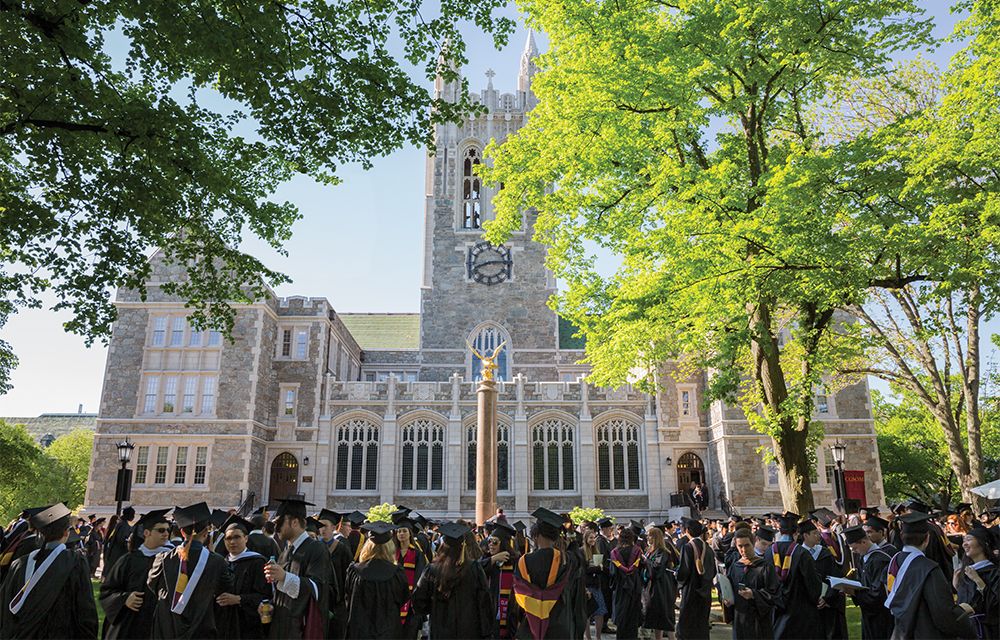
Dr. Michael A. Smyer, an accomplished teacher, scholar and administrator who has been serving as co-director of the Sloan Center on Aging & Work at Boston College since 2005, has been named provost at Bucknell University. He will begin at Bucknell in July.
|
|
Boston College Advanced Study Grant
Several undergraduate Psychology students have won an Advanced Study Grant: Faith Goronga, advisor Gilda Morelli Rene Lento, advisor Karen Rosen Colleen Maher, advisor Gene Heyman |
|
Inner Worlds
Research by Thalia Goldstein and Ellen Winner has found "that actors had higher rates of engagement with fictional worlds, made up worlds, and their own inner states and emotions that nonactors." A paper describing this research, titled "Living in Alternative and Inner Worlds: Early Signs of Acting Talent," has been accepted to the Creativity Research Journal.
|
|
Arts and the SATs
A recent New York times article, "Drawing Lessons," cites Ellen Winner's research on education and the arts: "There is indeed a correlation between, for example, how many years students spend in arts classes and their SAT scores; more art, higher scores. But that doesn’t prove that it’s the added exposure to the arts that boosts verbal or math performance."
|
|
Elizabeth Kensinger wins Distinguished Research Award Elizabeth Kensinger has won Boston College’s Distinguished Research Award. One junior faculty member from the entire university is selected each year for this award. She will receive a plaque and other goodies at Faculty Day, May 2. |
|
Memory tradeoffs
Research by Jill Waring and Elizabeth Kensinger correlates the contents of memory for emotional scenes with several types of individual differences. "Results suggest that greater anxiety, poor visuospatial working memory, and poor executive function may inhibit formation of complete mental representations of complex emotional scenes," says Jill. Their findings are to be published in an Emotion and Cognition article titled, "Impact of individual differences upon emotion-induced memory trade-offs." |
|
Contribution to Community Award Eliza Bliss-Moreau has received this year's Graduate School of Arts and Sciences Contribution to Community Award. She will also be the commencement speaker at the GSAS degree ceremony. |
|
Elizabeth Kensinger receives award and grant
Elizabeth Kensinger has been named as a 2008 Searle Scholar. The Searle Scholars Program recognizes "individuals who have already done important, innovative research and have the potential for making pivotal contributions to biological research over an extended period of time." With the honor comes a three-year research grant. |
|
Anger aids aggressive gaming Manipulating your emotions by electing to feel anger is a good way to prepare for an aggressive task, according to Maya Tamir, whose research is feature in two new articles. New Scientist and Science Daily describe how Maya's research shows that listening to angry music before playing an aggressive computer game like Soldier of Fortune improves game performance, whereas it does not help with a game like Diner Dash, about waiting tables. |
|
Practicing music increases corpus callosum thickness
In a new study, researchers including Boston College's Ellen Winner and Marie Forgeard have found that young children who practice music regularly develop a greater connection between the hemispheres of their brains. An article detailing their finds is available at Science.
|
Psi Chi Induction Ceremony
 
Psi Chi inducted 57 new members during this year's induction ceremony, held Friday, March 28 in Gasson 112. |
Acting and Theory of Mind
At the 11th international conference of the International Society for the Empirical Study of Literature and Media, Thalia Goldstein will discuss several of her studies in which she looks at "the connection between acting and theory of mind." Her talk, "Finding the Mind's Construction in the Face: Acting and Theory of Mind" has been accepted for the conference this July.
|
Learning affective value under minimal conditions
In a paper titled "Individual Differences in Learning the Affective Value of Others under Minimal Conditions," Eliza Bliss-Moreau presents "evidence that people can learn the affective value of many other target people, quickly and efficiently, when presented with only minimal information about the behavior of those target people and, furthermore, that the learning is retained over time. We also show that people who are self-report being high in extraversion show an enhanced propensity for positive affective learning." Eliza's first-authored paper was accepted to the journal Emotion.
|
Alisha Holland awarded fellowship
Alisha was awarded a National Defense Science and Engineering Graduate fellowship from the Department of Defense. The fellowship will pay her stipend and fees, and provide Boston College with a cost of education allowance, for three years.
|
Memorizing Pi
In the March 25 Boston Globe, Elizabeth Kensinger discusses the ability of Boston College senior James Niles-Joyal to memorize thousands of digits of pi, and the potential applications of his memorization techniques for those with impaired memory. Elizabeth is quoted in the article "Digital Man."
|
Why do we cry at sad films?
Thalia Goldstein will give a talk at the 2008 APA conference in Boston August 14-17. The accepted talk, titled "Why Do we Cry at Sad Films? Identification and Fiction," will question "Why are we so attracted to fictional worlds, and why do we feel what feels like real emotions in reaction to events we know are fictional?" It describes a study where participants watch movies that they know are fiction or that they think are based completely in reality, and their emotional and cognitive reactions to the movies, versus their emotion and cognitive reactions to real sad events in their own lives. Despite theories that say that people react more strongly to fiction than reality, we believe that identification plays a stronger role.
In addition, she will give a talk called "Facing Future: New Voices in Aesthetics, Creativity, and the Arts." The talk will cover her general research program, including the role that acting training has on theory of mind, empathy, and emotion regulation in both children and adults. She will talk about her studies of children and adolescents looking at acting training and its positive effects on theory of mind but not empathy, as well as her study on college actors and their emotion regulation techniques in context versus in general. |
Constructing Emotion
Kristen Lindquist's first authored paper, "Constructing emotion: The experience of fear as a conceptual act," examines the hypothesis that an emotion is a psychological event constructed from the more basic elements of core affect and conceptual knowledge about emotion. Her findings provide the clearest evidence to date for a constructivist model of emotion, which suggests that emotions are states that can be decomposed into more elemental parts. The paper is coauthored with Lisa Feldman Barrett and has been accepted for publication in Psychological Science.
|
Body Talk
Professor Joe Tecce has analyzed a "60 Minutes" interview of Roger Clemens to determine whether Clemens' body language makes his comments about steroid use more or less believable. Professor Tecce judges that Clemens' blink rate, body movements, and redundancy and stumbling in his speech suggest "a strong likelihood that Clemens was not telling the whole story." The full article is available on the College of Arts & Sciences page.
|
Ehri Ryu joins the Department
The Psychology Department is very pleased to announce that we have hired a new quantitative psychologist, Ehri Ryu, who will be joining the faculty in the fall of 2008. Ryu is currently finishing her Ph.D. at Arizona State University. Her interests include multilevel modeling and longitudinal data analysis.
|
Persuasion Techniques and Charitable Giving
Professor Kevin McIntyre's Social Psychology class explored a practical use of their study of "Persuasion Techniques and Charitable Giving" in their final projects last semester. The Heights reports that by using techniques learned in class, the students raised $1,015 for the The Greater Boston Food Bank.
|
|
Emotions come from physiology, experience, and context
In an interview in Psychology Today, Lisa Feldman Barrett explains that an emotion is formed by "a flexible negotiation between general biological reflexes, social conditioning, and deliberate thought" that is different for each person—not merely a standard response common to everyone. The article, "Name that Emotion" appears in the February issue.
|
|
Blink activity and the presidential candidates
A Japansese TV show plans to air a segment on Professor Joe Tecce's study of blinking. Professor Tecce finds that John Edwards and John McCain are "very very fast blinkers," and Barack Obama and Mike Huckabee are also fast blinkers; judging by blink rate and body language, Hillary Clinton and Mitt Romney are more likely to receive their parties' nomination.
|
|
Aging brings changes in emotional processing
In a paper co-authored with Prof. Elizabeth Kensinger, postdoctoral fellow Christina Leclerc reveals an age-related reversal in the types of emotional information that elicit the most activity in a region of the ventromedial prefrontal cortex. While young adults show the most activity in that region while viewing negative images, older adults show the most activity while viewing positive images. The paper will be published the journal Cognitive, Affective, and Behavioral Neuroscience. A second paper, to be published in the European Journal of Cognitive Psychology, reviews the literature suggesting that there are age-related changes in the neural mechanisms that support emotion processing. |